In 1950 the Glossop Chronicle and Advertiser published a series of twelve articles about Glossop pubs under the above title (though, strictly speaking, a couple were in Longendale). This article contains scans of the photographs and transcriptions of the comments published alongside them.
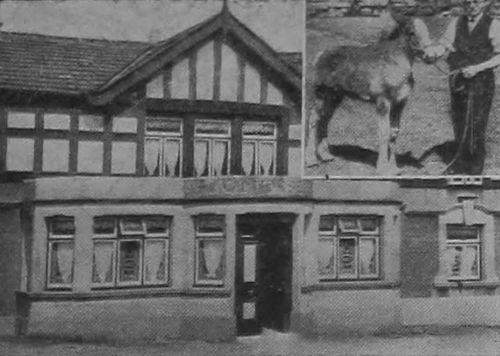
The Norfolk Arms.
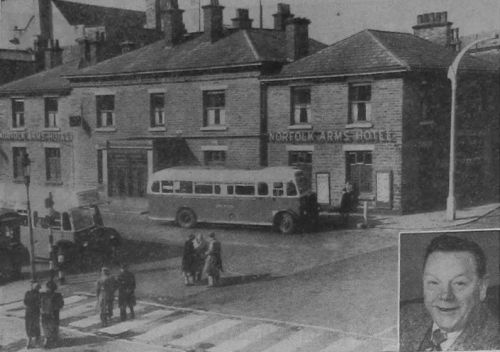
The Norfolk Arms with (inset) Mr. E. Smith, the licensee.
|
“To take one's ease at one's inn,” is something that few can resist and for people in the
Glossop district there are plenty of friendly inns (how much friendlier this word sounds than hotels or public houses) to choose from.
Each week we hope to spotlight one of these friendly places where friends meet and talk of the past, present and future. First, the Norfolk Arms, named after an aristocratic family and probably known further afield than any other Glossop hotel.
In the town's centre, standing back from the road it has a handsome frontage and is a talking-point for all sections, In the Norfolk one can invariably find a councillor listening to a tale of woe or hear some sporting gossip.
The present licensee of the Norfolk Arms is Mr. Edward Smith, and he and his wife and daughter, Mrs. Jeffreys, must be three of the best known people in town. Mr. Smith, usually to be found with a smile on his round, red face, thinks business has increased considerably since he took over the Norfolk Arms.
Many organisations take advantage of the catering at the hotel. Three mayoral functions have been in his hands at the Town Hall, as have those connected with leading
mills in the district. During the war Mr. Smith recalls the time when the Norfolk was almost completely “occupied” by the troops – one night about 70 soldiers crammed into the place to sleep and the billiards room was packed! The Signals Corps still make the hotel their H.Q. when out on exercises.
Mr. Smith succeeds a long line of licensees, names of whom are still household words in the town, and recall many happy evenings spent “in 't Norfolk.”
Remember Joe Collier, Alf Charlesworth, John Joseph Pickford, Joe Kirwin? They kept the
Norfolk Arms at one time or another since the turn of the century.
Alf Charlesworth cannot be easily forgotten. His face looks down on the bar. Alf was one of the “star” North-road batsmen of his day, and is on a photograph on the wall of the Norfolk Arms. He ranks along with such “immortals” (at least in the eyes of Glossop folk)
as Sam Cadman, Irvine Dearnaley, and Olivierre, the West Indian, who died only a year or two ago.
In one sense the Norfolk Arms has been the headquarters of cricket in the town. The District League “back room boys” meet to formulate policy in its precincts to-day just as they have done for years, and many a sportsman's speech has echoed inside the Norfolk Arms.
Football teams, some of them in the First Division, often call if they are making the Lancashire to Yorkshire journey.
When We called to see Mr. Smith at noon on Easter Monday, he was waiting to welcome a football team for lunch. He is an old Rugby player, and won a Rugby championship medal with Wigan 28 years ago.
Before he and his wife came to Glossop 12 years ago, they kept an off-licence and grocery business in Wigan.
Just over fifty years ago the brewery firm of Gartside's bought the Norfolk Arms from Lord Howard and its whispered that a sum of about £4,000 changed hands in the deal. Naturally, it then ceased to be a free house as Lord Howard always preferred it.
In the old days this hostel was a favourite calling-place for the stage-coaches and there were stables at the back. One could hire a horse in those days and proprietors of the
Carriage Company were Fielding and Bagshaw.
First landlord we can trace is Mr. Woodcock. It was in the days when people brewed their own beer in the backyard and one 84-year-old gentleman recalls that the beer was
much stronger and cheaper then. You could get a drink any time of the day at the Norfolk - a good drink, a smoke and some change back out of your sixpence!
Crowds came to the Norfolk when it was fair-day in May. Farmers came from throughout Derbyshire. Where the buses draw up in the square nowadays there were brandysnap stalls huddled together and inside were the long pipes known as “church wardens,” each a favourite of a certain customer and each waiting to be claimed.
A reader who has been going here for over 60 years cannot remember them engaging special throwers-out as they did at some of the public-houses when opening
hours were not so strict and beer (so we are assured) was stronger.
Rose and Crown.
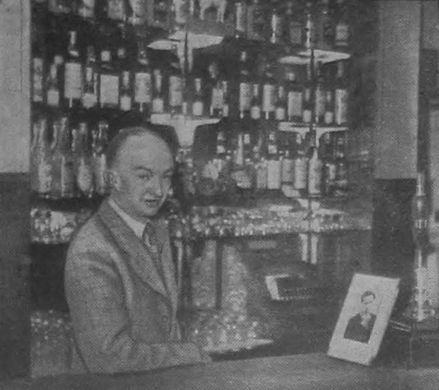
Mr. Albert Scragg with the photo of Sir John Barbirolli, which the
Halle conductor autographed when he visited the Rose and Crown.
|
The Rose and Crown at Christmas time! A place of colour and enchantment which would have delighted Dickens. You will not find a warmer welcome in town nor a more brightly decorated hotel.
Yet, strictly speaking, our happy calling-place this week is not an hotel. The Rose and Crown in Glossop's main street is large and roomy and host, 47-year-old dapper
Albert Scragg, would willingly “put people up” for the night if only he could obtain fittings for
those spare rooms.
Hotel on a grand scale it may not be but few will deny that it seems just that little bit more effectively transformed with streamers and Christmas trimmings than most meeting places in the town. Perhaps the secret lies with Mr. Scragg. The stage means life and
colour and this friendly little man was playing in Shakespeare a quarter of a century ago.
He did not always touch such heights. There was “The Walls of Jericho” at Newton Heath with Albert as Lord Marchmont, and “Trespasses” at Failsworth. And how many Glossop folk saw a certain “Harry Plimmer” billed in “Father Forbids the Banns,” along with “The Lancashire Players” at the Winter Gardens, New Brighton in the summer of '28? It was Albert Scragg on tour.
For 10 years this Ashton-born licensee has been in Glossop, and during that time somebody called who will be remembered for a long time in the Rose and Crown, Sir
John Barbirolli - then plain Mr. - popped in for a drink two or three years ago and Mr. Scragg, keen music-lover had a long chat with the famous conductor.
The Rose and Crown is a home of classical music. What it lacks in historic stories is made up for by the strains of Rossini or Liszt (our host's favourite composer) that are likely to greet you as you call for a mild.
But this inn has other associations. Up the flight of stairs is a door with a mysterious section. Only a confidential knock could gain admittance to the meeting of staunch Oddfellows who used the Rose and Crown upper rooms as their headquarters many years ago.
And other organisations such as the Foresters were there, too. Old members of the movement will need no reminding of some of the names who served behind the counter downstairs at the Rose and Crown: Collier, Mayhew, Farnworth, Bridge, Birch, Walt. Locking and Alf. Hayes. These must have made many friends over the glasses.
The vault here claims its adherents. A favourite inn is a second home. And for people such as 73-year-old John Hall, who lives only a few yards away from the white sign that swings in the sun as shoppers move along High-street West, the Rose and Crown holds
many memories.
Rex and Bobby, a fox-terrier and spaniel, wagged their tails merrily as we bade goodbye to Mr. Scragg, and five-year-old Margaret knocked over the dominoes. The vault was empty. Opening-time had not arrived. Later, the cosy room would echo to more voices of people taking their ease in the Rose and Crown - where one hears Mozart as often as a popular song, and where a line from the Bard of Avon does not seem out of place.
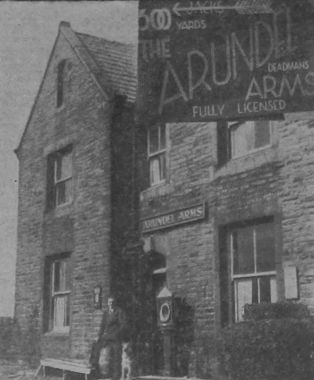
Arundel Arms.
In the summer the Arundel Arms faces slumbrous meadows and from its windows one can look out on the grandeur of bare, beautiful hills. But in the winter it stands, lonely and forlorn-looking, amid huge snow-drifts for weeks at a time.
The Arundel Arms, also known as the “Deadman's,” is the second highest hotel in the Glossop district, and only 50 yards from the cemetery (Now don't dare to ask how it got its nickname!)
“Deadman's” it always has been, and, we think, always will be, for many of the visitors who spin out from Manchester at the week-end and draw up on the clean, curving,
Cemetery-road, ask the licensee “Don't you ever get nervous living up here?” And although they probably always laugh it off and say “No,” they surely have thought the question over again as the wind blows up from the Longdendale reservoirs, howls round the gravestones, across the fields, and shakes the trees into mournful cries at midnight.
There is no house near “The Deadman's.” Three hundred yards away a sign beckons to the wanderer to test its ale. From the sign to the hotel, the wanderer has to pass the cemetery gate ..
But there's the other aspect of the picture - the sun-splashed hills, laughter on a summer's night, and plenty of cars on the lonely road.
And, around the cosy bar, echoes of some of the blithe spirits who served drinks at “The Deadman's,” Arthur Roe, Jim Hadfield, George Lewis and Harry Torkington, licensee during the war, and the man who raised money for charities by displaying his fine collection of brass articles to customers.
Says 76-year-old Harry Torkington: “Healthy? I'll say it's healthy at the 'Deadman's.' I wouldn't mind being up there now.”
The Arundel Arms was for many years a “free house” until Arthur Roe sold it to Clark's, brewers, of Stockport, and it is the only public-house belonging to this firm in the
district.
A few years ago two young men, Lloyd Jackson and Arthur George Currums, settled in the Arundel Arms. It was their first venture in the licensing trade, Mr. Currums joined his friend when he finished serving with the R.A.S.C. on the Continent. Mr. Jackson died not
long ago and the former is now the sole licensee. But whoever goes there now is sure to meet Zenda. She's not a barmaid, but a friendly Alsatian.
Nearly every year the Arundel Arms gets “snowed-up.” In 1946 it was almost completely isolated for seven weeks. But the beer never ran out and occasionally some
brave soul tramped through the snow and ice for a “gill.” It was the worst-ever snow period for the hotel. A grim wait for the great thaw and an experience our present licensee does not want again.
But soon the buttercups will be opening across the road and the Arundel Arms can drowse in the afternoon sun like the cows opposite. Trade increases with the fine weather and there is ample compensation for the cruelties of winter.
The Arundel Arms is now a residential hotel. It has been modernised inside and only recently pumps have been placed on the barrels. And yet to the stranger, casting a glance at the neighbouring cemetery, it will always seem rather awesome. And, like us, he will half-believe that if a pint of ale is left standing on a back windowsill at midnight in the cool air it will have been drunk in the morning by somebody or something, unseen and unknown.
The Grouse.
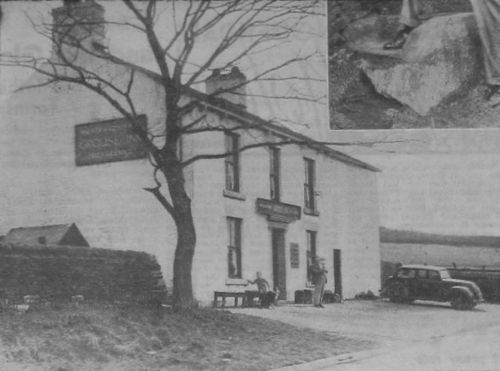
The Grouse faces the hills.
(Inset) the Abbot's Chair on Monk's-road, not far away.
|
Larks sang in the clear air as we climbed Chunal-road and made our way to that delightfully-situated hotel - The Grouse. Standing white and solitary it faces the gaunt shoulders of the Nab and the winding Monk's road and from any of its windows one looks out on the graceful sweep of the hills round Glossop.
There's little to grouse at if you go to the Grouse on a spring day with the rather battered tree which stands by and only blooms on one side because it catches the keen winds on the other, daring to bud. and Rover, the black-and-white dog bounding out to greet you.
Inside there is still no electricity and not so many years ago it was oil-lamps, not gas. Now there's a cosy dining-room and modernised bar, and a big smile from Mr. Cyril Bradley and his wife Jessie for travellers. And casual travellers have for so long supplied
a lot of the trade at the Grouse Inn. A “refresher” at the Grouse has been a prelude to a strenuous climb over Kinder Scout. Mrs. Bradley still recalls with horror the day during the war when a man who had parked his cycle at the inn returned with his face covered in blood and in an exhausted state as a result of an accident on the moors.
Now Mrs. Bradley will tell you that she can think of no fairer place to live - or die, for that matter - than at the Grouse, with the sheep nibbling on the hills, and only bird-song to disturb a summer morning. Even the fact that for several weeks a few years ago no vehicles were able to pass the Grouse because of the snow block, doesn't change this view. “Mine host” had once to climb through a small window to get out of the snow-surrounded house.
But what about the days when only ponies and traps could make the tiresome journey into Glossop for the beer? Genial, red-faced Albert Pass still happily farming in the vicinity, kept the Grouse for 20 years. He remembers when food and goods arrived at the Grouse only once a week. He also remembers with a wistful look on his tanned face, when “a small rum” was 2d. and a gill of beer 1d. Mr. Pass was the first to get a Sunday extension at the Grouse, and after this, other lonely places such as the George and Dragon, Woodhead, did the same.
In the war it was nothing unusual for Mr. and Mrs. Bradley, who have been at the Grouse 14 years - (“What a contrast to that part of Manchester I come from”, says Mrs. Bradley) - to be turned out to sleep elsewhere during air-raids. The Grouse was in a decoy
area, so that it stood a good chance of being demolished by bombs. Fortunately it remained unscathed.
Then came a slump with petrol rationing. The number of motorists who called became fewer. Peace upon the hill-tops was even more profound. But now it is more often
broken and cars are being seen again outside this landmark.
Jim Hall, Harry Smedley, Joe Bennett, and, in the last century, a Mr. Stephenson, who also kept the Rock Tavern, and was in the quaint position of holding licences for the Grouse and Surrey Arms at the same time, kept the Grouse at one time or another. A free
house for many years it was bought by Walker & Hompfrays in the 1930's.
Always a point of interest to callers at the Grouse is the Abbott's Chair, not many yards away along Monks-road, leading to Charlesworth. Thought to be a relic of about 600 years ago, it is most probably on one of the sites of the meeting-places of monks of the
Cistercian Order.
George and Dragon.
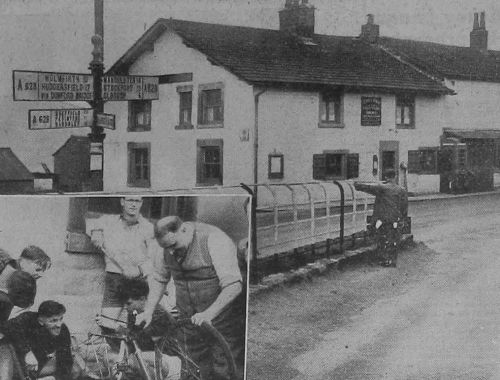
(Inset) “Eddie” Bagshaw is popular with the cyclists.
|
Cricket comes with the merry month of May, so it was appropriate that we should drop in
at the George and Dragon, Woodhead, on the clearest of Sunday mornings, when the sound of ball and willow would not have been amiss. For recollections of former Derbyshire cricketer, Harry Bagshaw, always come to mind when this widely-known roadhouse, standing a few miles out of Glossop on the main Manchester-Sheffield road is mentioned.
Now the Bagshaw tradition is carried on by his jovial son Eddie, and his wife. Eddie's mother, Mrs. Bagshaw kept the George and Dragon until quite recently. And it's still a popular spot for cricketers. Herbert Sutcliffe often calls. Cyril Washbrook and Bill Roberts, Lancashire players, were up earlier this year. Len Hopwood, former Test player, also talked over the game with Eddie when he called recently.
The fact is that few motorists or cyclists can resist this cosy inn after they have basked in the glorious scenery of the reservoir-studded valley which stands between the George and Dragon and the industrial areas. Beyond the glistening water of the five reservoirs and the tree plantations (which make the area seem like a picture postcard view of the Canadian Rockies) the George and Dragon is visible for some distance on the winding roads on either side of the valley.
For 305 years it has been a welcome haven for travellers. On the walls of its low roofed rooms are documents telling of stage coach stops to London and York - a four days' journey - and the opening of the Woodhead tunnel. Many men working on the new tunnel have come to know the George and Dragon, Cyclists come in their thousands and the host is just “Eddie” to most of them. His hearty laugh makes everyone at home.
Waters of the reservoirs lap the shores only a few yards away from the George and Dragon and the bleak and barren hills rear up out of the water. This scenery makes it a popular spot for wedding receptions -and there's always the excellence of the catering to consider.
Anyone who has been in the George and Dragon must have played the “nickel-odeon.” At least that's what they're calling it now, so Mrs. Bagshaw, junr., told us
with a smile, It's no modern contraption. It has stood in a room facing photographs of Roy Kilner and Prince Ranjitsinghi for years and its merry tinkle still guarantees a smile.
Yorkshire visitors still give Eddie all the latest news of cricket discoveries in that county. Eddie still recalls with pleasure the visits of two Australian Test teams to the George and Dragon - in 1934 and 1938.
In this century the George and Dragon has become a place of renown. What of the other centuries? Even small scattered hamlets like Crowden and Woodhead can change, though only local historians notice the difference as an odd house disappears.
There used to be two other public-houses in the vicinity – the Angel and the Quiet Shepherd. Now the George and Dragon stands alone. But on the ride from Tintwistle many quaint things attract the eye.
The mysteriously shaped building on your left, for instance. ...
The Monkey House - or Saunder's Cross House - was formerly an old place of Christian worship and it gets its name probably through its amusing shape.
Travellers in the George and Dragon direction must have had to pass the toll-bar in the old days. They would go along the old Roman road which came out near the Quiet Shepherd. It is said that John Wesley took this road and got lost on Tintwistle Knar.
Hollins Clough is another beauty spot between Tintwistle and the George and Dragon. Named after an old family who lived many years in the locality, the water in it goes
down steps, under the road, and along by the reservoirs until it reaches Arnfield.
Crowden Hall was built in 1692. It was bought by Manchester Corporation on the grounds that cattle polluted the drinking water and they could not turn the people out without buying it. Services used to be held at the hall. Over the door are the initials T.H.E.D. 1692 and they probably refer to Thomas Hadfield, member of a family who owned the hall for generations, who must have been lord of the manor or squire at Crowden.
Many houses in Crowden have been demolished. Most people there now work on either the railway or the corporation water-works. Crowden, or Crow-dene, actually means “valley of the cows.”
Manchester Corporation started a division of their company in these parts in 1847. They cleared the valley and started to build reservoirs.
The reservoirs from Tintwistle to Woodhead are Bottom's, Vale House, Rhodes Wood, Torside and Woodhead rising from 400 to 800 feet above sea level.
All this grandeur there is for the cyclist and motorist and rambler - and Wilfred Pickles described a lot of it when he did a broadcast with Eddie and his mother a year
or two ago. They went “on the air” after B.B.C. producer Joan Littlewood had found what a cheery family was to be found in the George and Dragon any day in Spring or Summer.
We found one on Sunday. They all had a friendly Yorkshire accent. They had come in a coach. One of them said: "Every year, on the first Sunday in May we come on this trip from Huddersfield to the George and Dragon. We wouldn't miss it for worlds." And, as we
watched the wavelets scurrying across the reservoir surface and inhaled air as rich as wine, we thought that this was another example of the Yorkshireman's good sense. The George and Dragon really gives you a breath of old England that's to be treasured.
Howard Arms.
Where once the feet of nobility strode a man with a Frisby Dyke accent now serves drinks in Glossop's oldest hotel - the Howard
Arms.
At least most people seem to agree that it's just about the town's oldest. Some claim the distinction for the Bull's Head, Old Glossop. The answer lies somewhere between the two, we are sure.
But when a hotel can boast of a passage, secret or otherwise, stretching nearly a mile to Kingsmoor School, former home of the Howard family and walls that resemble those fairy-tale castles for thickness, then it is bound to have an air of antiquity. Dick Turpin is reputed to have stayed at the Howard Arms.
The Howard Arms was originally a farm and towards the end of the 18th century a member of one of Glossop's most prominent families, Mr. John Wagstaff, obtained a spirit
and beer licence.
Past landlords include James Hulley, William Ross and Frank Potter who left only six months ago for the wilds of Somerset. Now Mr. and Mrs. Ernest Robinson, with their seven-year-old daughter, Heather, are in occupation and Mr. Robinson agrees that the Howard Arms is situated in a healthy spot. For over 20 years he was steward at a men's club in Wallasey.
The Howard Arms, its sign, doors and windows, shining under a new coat of red and gold paint stands back from High-street East - the road that leads into the Snake Pass. In the old days travellers would pull up their horses to rest.
In its rooms much of the business of the town was dealt with. More than a century ago the only convenient place for public meetings was the Universal School later demolished to make way for the railway station. So the Howard Arms was used.
The first mail coach from Sheffield to Manchester passed through Glossop on May 27th, 1822, and a special dinner was served that day at the Howard Arms. Over sixty of the principal people connected with the making of the new road between the cities which shortened the route (previously going through Buxton) by fifteen miles. But still the journey took five hours – and that was on favourable days!
Living rooms and a section of the bar at the Howard Arms are even now below street level. Light streams through the window-roofs as it must have done when roads round Glossop were nothing but lanes and footpaths fit only for horses or foot traffic.
Hare and Hounds.
“I've seen a bit of the world. I've seen the Himalayas and the Taj Mahal. Often when I was
in the thick of the Burma campaign I used to think of this quiet little pub nestling on the hillside.”
The voice was that of Mr. William Day of Charlesworth and the quiet little pub was the Hare and Hounds, Simmondley – the building itself is in Glossop but the Charlesworth boundary runs through that pleasant patch of garden at the side so that it is possible to hold a pint in Charlesworth and drink it in Glossop!
The Hare and Hounds, built 1784, is just the type of hostel to capture the imagination of the soldier serving in some far country. Many will contend that it possesses the finest view from its door of all Glossop and District Hotels. Situated at a point higher than Dinting Arches which it faces it looks out over the valley and the generous sweep of the North
Britain hills. Deep Cutting on the Stalybridge road and Mottram Church are easily visible. And around the Hare and Hounds, are serene little cottages (everyone seems to love a garden in Simmondley) with a tinkling stream not far away while the Nab looks down at the back with a rugged benevolence.
Ex-police officer Bob Savage has good reason to be pleased with his choice when he left “the force.” He and Mrs. Savage and their daughter and son-in-law (Mr. and Mrs.
Turner) are becoming some of the best known hosts in the area. Bob's a big, burly man with a pleasant smile and one customer tell us that he's the only man who can cut his own hair. Whether that's true or not he's sure to remind old 'uns of an almost legendary character who was also a big man.
The late Sam Dewsnap was so big that they called him “Big Sam.”
He kept the Hare and Hounds round about the turn of the century and those who remember such things still picture him striding along the Charlesworth road with his beloved dogs. Who can forget “Mounter” winner of countless trail hunts? In Sam's days trail-hunts started from the Hare and Hounds.
-and his pickles
“When Sam was talking about dogs you had to shout more than once before you got served,” we were told on Sunday night. And we heard descriptions of the thick cheese sandwiches and pickles he used to serve up - not to mention his own appetite. Sam Dewsnap and his dogs still haunt the Hare and Hounds. But inside it is changed. The three rooms have the brightest lighting, one has been panelled, and on the walls are multi-coloured murals by Glossop's artist - landlord Jim Hinchliffe.
It is nothing unusual to see over a dozen cars outside the Hare and Hounds at weekends. Years ago it used to be a place for farmers and residents in the old-world village but now its reputation extends to “townies” and many a coach-party finds it refreshing to sip drinks outside on a deck-chair while insects of summer buzz by.
There used to be a bowling green at the Hare and Hounds, but this has gone now. Nevertheless, it is one of the few places where hawthorn hedges smell sweetest on a spring night and where a drink only enhances the delight of the surroundings.
Nearby is the tiny Simmondley Sunday School and at harvest-time a collecting box always awaits the visitors to the Hare and Hounds.
The Hare and Hounds is the only Tetley's house in the Glossop district. Next one is in Stalybridge. Since Sam Dewsnap kept it many landlords have come and gone - about 20. But the “locals” still call in and talk of Sam and his dogs.
Friendly old men such as George Robinson, John Orme and Lister Broughton, all around their “eighties.” And there is Alf Henshaw, who we were told, is the “uncrowned king of Charlesworth.” For the Hare and Hounds is in a lovely and health-giving spot which
is likely to keep a man living for ever.
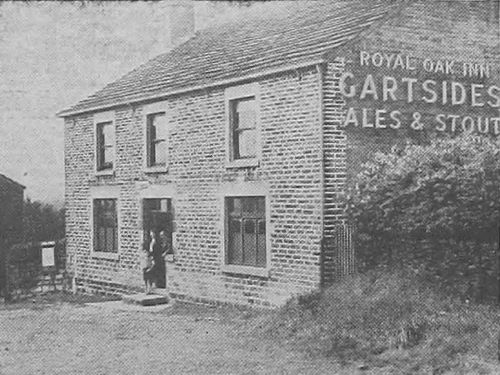
Royal Oak.
Many years ago a certain Mr. Eckersall was one of the best known gardeners in Glossop. He was employed on one of the brightest gardens in town. Then he and his mother and four-year-old daughter went to live in Lancashire.
Now the grandson of this gardener has returned to Glossop and has taken over what has been described as the “last hotel before you get to the mountains.” He is Mr. Walter Fletcher, licensee of the Royal Oak Hotel, who, with his wife, Betty, and seven-year-old son, Christopher, are now living in the town, which as youngsters they heard so much about from their grandparents.
Records trace the history of the Royal Oak back to 1836 and it has always been a favourite haunt for the detachments of shooting men who would comb the countryside
around the Snake road and then settle down for a cooling drink.
The Royal Oak is yet another Glossop hotel with a view from its windows to make the blood tingle. It looks out on the Glossop golf links and the Snake-road and when dusk gathers over heather and bracken hillsides the twinkling lights of cars can be seen as they sweep down off the Snake-road into Glossop - and the Royal Oak is usually their first call.
Just as the Grouse is the last stop for most people travelling out of Glossop in the Hayfield direction, then the Royal Oak is for those going towards Sheffield.
Probably the most popular of licensees remembered at this hotel is Mr. Frank Ashton who before and during the war was there for 18 years. Others will recall George Fielding, William Langford, Ralph Bradley, Mark Dixon, Ben Bowden, and Sarah Sykes although
this is taking us back about 100 years.
Once in a more isolated spot the Royal Oak is now the closest public house to Glossop's new housing estates along Sheffield-road and Pyegrove and its smart, brightly painted exterior are a protection against incongruity with its freshly-built surroundings of stone and mortar. Yet at the back stands the dark, tree covered lump of Castle Hill, emblem of pre-historic times when the whole of the valley was trees and shrubbery and cosy inns like the Royal Oak undreamt about.
Typical of those old days when it was dangerous to ride alone along the Pennine range is the story told by many an old customer at this inn. A traveller is supposed to have drunk well at the bar one night in the last century and then set off on the dark highways. Later his body was found by one of the grey stone walls that split the sloping fields off the Snake-road. And it is said that the murderer was never found .....
But such macabre tales do not disturb Mr. Fletcher these days. Since coming to Glossop from Whitefield eighteen months ago they have made many friends. Now with petrol off the ration they hope to make more. For, after the inspiring views from the top
of the Snake-road what could be more satisfying than to pull up at the first hotel “after the mountains?”
Pack Horse (Mottram).
Hundreds of pairs of eager eyes concentrate on the fields that slope up from Hyde-road
which gleams in the sun. Black specks move down the hillsides from Matley.
“It looks like Mickey,” says someone in the gaily-dressed crowd in a field near the Pack Horse Hotel. There's a buzz of excitement as the specks draw nearer. They turn out to be dogs.
Such a scene could be witnessed during the August holidays at Mottram when the annual trail hunt meeting was held in the pre-war years and it is such happy-go-lucky hours that will be conjured up for many people every time they enter the Pack Horse Hotel, which although not in Glossop, is a firm favourite for all who gladly remember the “Good old days” of Mottram Wakes.
The Pack Horse is, or was, the home of Mottram's renowned trail-hunt. Present landlord, Mr. W. Andrew - he has been there 31 years - was trail-hunt secretary. Always about 30 dogs competed - remember the “regulars” - Cavanagh's, Woolley Bridge, and
Mitcheson, Hollingworth, with their sleek dogs usually among the favourites when the bookies made lists.
Last trail-hunt was held in 1939. “I was very sorry to see them finish” says Mr. Andrew. The war with its ploughing up of fields stopped them. But people who visit the Pack Horse wonder if there is a chance of reviving these meetings so beloved by sportsmen.
The fair always meant three big days for the Pack Horse. At least it did in pre-war days. A lot of the gaiety and attraction has gone from Mottram fairs now, but in the old days the vicinity of the Pack Horse swarmed with people and it ranked with show day as one of the most hectic times in Mr. Andrew's year.
Seven or eight people were required to serve drinks at the Pack Horse on such occasions. . .
Mr. Andrew came to the Pack Horse in 1919. He persuaded the previous landlord the late Joe Jackson, to stay in until he came out of the forces (he had viewed the place while on leave).
Joe Jackson kept the Pack Horse 10 years before him, and others will recall Joe Taylor and H. Tomlinson as other hosts. In 1923 the place was enlarged, and now has an impressive old England-like black and white timbered aspect. Black and white tiled floors and flower-brightened interior make it exceptionally cool inside on hot days such as we have had this week.
Originally, 40 acres of ground were attached to the Pack Horse, including the present Mottram Show ground. It is one of the few “pubs” in the district attached to a farm - the Robin Hood, Mottram Moor, is another.
The Pack Horse can truthfully be described as being, in one sense, the headquarters of Mottram Agricultural Society, and it is here that the farmers proudly plan their programme. Mr. Andrew himself has always taken the keenest interest in the show as an official and exhibitor. He was the first to win the cup awarded for the best foal sired by Mottram and District Shire Horse Society given by Mr. C. Hall. And here we come to another organisation almost 'born and bred' at the Pack Horse-the Shire Horse Society. To non-farmers this society may often seem rather a mystery, but it has done much to promote the standard of breeding in the district. The present landlord was one of the founders and a former secretary, and the horse was always stabled in the Pack Horse grounds.
There is a stag's head at the Pack Horse. It is a memento of the days when Mr. Harold Chapman had his pack of beadles. The stag was killed in November, 1912, and
is believed to be the only stag killed in this area. The beadles were a popular sight at Mottram, and other packs from such places as Macclesfield and Penistone gathered every Boxing Day at the Pack Horse.
More unusual animals have greeted customers, too. Many readers will remember the five monkeys Mr. Andrew kept 'way back in 1929. A Mr. Jennison, of Belle Vue Zoo, asked him if he would try them out under a Mottram “climate.” They proved friendly little things, although Mr. Andrew recalls with a smile that two were rather rough at times. Anyway, one survived and afterwards he went down to see it at Belle Vue. It must have been Mottram air that kept it in good health, for beer was not on the monkey's menu!
Other bodies that have made the Pack Horse their “home” are the Refuge Lodge of Oddfellows and the Northern Alsatian Training Society. But for the summit of quaintness we must go back to a summer's day in 1926 when Mr. Harold Chapman gave Mottram a
new crown pole. To commemorate the gift a dinner was held in his honour and this became an annual event - but only those present on the first occasion could attend each
year and when they passed away another chair at the table was tipped up, never to be filled again.
Those who sat down to dinner on that memorable July day included, besides Mr. Chapman, Tom Bennett, G. J. Awburn, W. Beaumont, John Brodrick, Tom Phillips, Goddard Rhodes, R. G. Gunnell, Robert Newman, A. G. Hulme, J. B. Seville C. E. Halton,
James Shaw, A. Hallsworth, A. Pritchard, Reg Shaw, James Wilson, Eli Morgan, Sam Ford, Sam Hudson, Fred Hyde, Percy Birch, Fred Eastwood, Alf Wych, Bob Leech, and W. Andrew. The last seven are still living.
Mr. Chapman was the only one allowed to bring a friend to subsequent gatherings, and friends who attended included Sir Charles Booth, Mr. J. Westbrook, C. Crease, and F. Helm. Mr. Chapman died in 1932 and afterwards his brother, Jack Chapman, was invited from Yorkshire.
Even now when a member of this unique group dies his fellow-members send a wreath in the shape of the crown pole and always attend the funeral if at all possible.
And to repay his friends for their annual hospitality Mr. Chapman would take them on a day's trip every year. “Grand days” is how Mr. Andrew sums them up.
They are gone now. The Pack Horse is a hotel of memories. Farmers gather to talk over old show triumphs: visitors from other counties, calling in for a drink, recall the “days of glory” at the Pack Horse when its licence extended from 11 a.m. to 11.30 p.m. But amid all the nostalgia for past years, Mr. Andrew prepares yet another horse for the Mottram
Show, which he has never missed attending for 30 years. The Pack Horse may not be as busy these days, but it is still as pleasant and has an open-air atmosphere of a special kind.
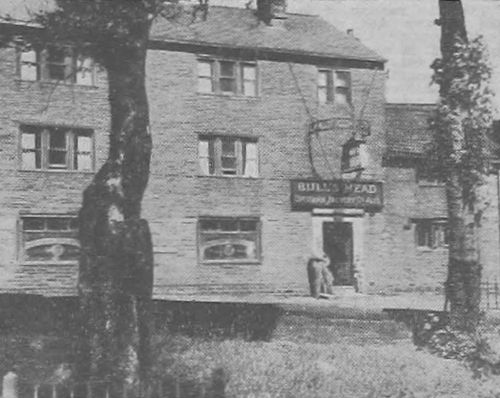
Bull's Head.
We came to the Bull's Head, Old Glossop, under ideal conditions - in the warmth of a June
morning and only a gentle breeze whispering in the tall trees in the quiet church grounds opposite.
The Bull's Head is an inn that claims antiquity and goes a long way towards proving it. Parts of the stone architecture suggest that it was built in the early 17th century and over the back door is a stone said to bear the date 1607 although a modern wooden verandah now hides this mark.
There are two inns of this name in the district - the other is at Tintwistle. As we gazed at it's quaint doorway and three foot walls and looked out over the sloping roofs of the oldest cottages in the whole of Glossop, nestling in the shelter of Shire Hill, we wondered how this old Glossop inn got its name.
Some contend that it dates back to a Papal Bull of the 14th century ordering that provision should be made in every town to meet the requirements of travellers. Others will tell you that the name rived from the bull-baiting which used to take place nearby. The stump to which the bull was tethered, sometimes called the beast post, is supposed to be still in the ground although covered by road re-surfacing.
In the bull-baiting, the bull was fastened by a chain to the stump and dogs set at it. The winner was the dog which held on longest against the infuriated beast's attempt to get rid of its tormentors.
In the low-roofed drinking rooms of this “old inn” it is not difficult to visualise these dark deeds by mankind. It could so easily have seen tragic and long-forgotten incidents standing on the fringe of the treacherous moorland paths that 200 years ago would be more forbidding than to-day.
But the June sunshine lit up the spotlessly clean tap-room as Mr. Leo Birt, three years the licensee and formerly an Inspector in the Glossop Police force, casually pulled out a box of coins that interest many visitors to the Bull's Head. Often he will cause an unthinking caller to splutter over his mild-and-bitter as he announces “I'm going to show you lady Godiva.”
Of course, the good lady does not stride forth from behind the counter. But she's there all right - on the back of a Coventry halfpenny dated 1793. And Mr. Birt possesses a half-farthing, a six-pence which was found in a goose, and a Macclesfield halfpenny 213
years old.
These are Mr. Birt's own but upstairs are some relics that have been passed down through the years - hand-bells. They were the property of the Glossop Hand-bell Ringers who won the English championships at Belle Vue on several occasions. When they won
it three years running a special medal was struck to commemorate the feat. Their headquarters was the Bull's Head. Now some of the hand-bells are rather dusty but their chimes still ring in the old years and bring back the 18th century triumphs of the musicians
who wielded them so skilfully.
The gaunt walls of All Saint's Church face the Bull's Head making it seem tiny by comparison. But the old inn keeps its secrets. The name gives rise to mystery and inside the atmosphere remains. The old pictures on the walls, the oak beams so low that an average sized man can easily touch them, and the winding village street with the cobbled footpaths add up to quaintness of a most fascinating kind.
Let Mrs, Birt have the last word: “I never tire of the view from my kitchen window.” For over 300 years people have looked out and seen through air drowsy with the heat of an English summer, cows on the hillsides, and thick-foliaged trees. Who would not want to
drink in such surroundings when he came to the end of the road?
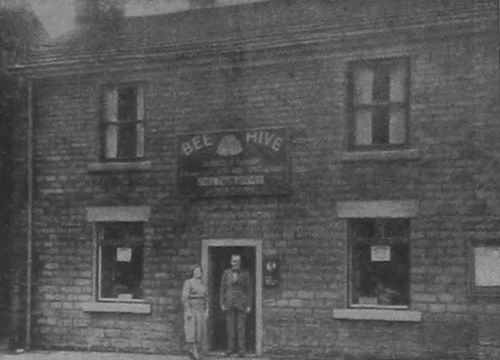
Beehive (Whitfield).
According to a notice in the bar at the Beehive, Whitfield, the perfect landlord must be a man of many faces. He “should have the dignity of an archbishop, the geniality of George Robey, the tact of a diplomat, the hope of a company promoter, the benevolence of a charitable institution, the eloquence of a Cabinet minister, the legal knowledge of a lawyer, the general knowledge of a sports editor, the smile of a film star, the voice of a sergeant-major - and the skin of a rhinoceros.”
i
“If he can say 'Time, gentlemen, please!' in a fruity voice which combines firmness, regret, condolence, hope for the future and thankfulness for past mercies, together with the suggestion that it hurts him more to say this more than the customer to hear it, then
the landlord is set for success.”
A formidable task to come up to that standard, but tall, grey-haired Alf Oldham gets near the mark. To-day is Alf's fourth anniversary of taking over the Beehive, and to-night there'll be congratulations and good wishes from his regular callers.
The Beehive's three-feet thick walls and low raftered rooms would suggest that it is many years old. It stands in one of the oldest parts of the town and is thought to have been built 150 years ago. Mentioned in Pigot's Directory of Manchester and District (1844) the Beehive was formerly two buildings – a butcher's shop and a house. Not far away is a cottage built in the early 1600s while the school down the road was erected in 1779.
Some people will no doubt remember former licensees at the Beehive - John Trueman, Miss Pilkington, George Nichols, Charlie Hadfield, and Hiram Morton. In Mr. Trueman's days the carters used to visit the inn from the adjoining quarry. One of the Beehive's treasures is a sycamore-topped round table which was used for paying out wages before the turn of the century.
Before Mr. Oldham came to the Beehive he was in the Isle of Man but decided to come back to Glossop (he was formerly steward at the Central Conservative Club) for “some fresh air.” Up there on “the roof of Glossop” Mr. and Mrs. Oldham never tire of the view down the valley.
Then there's the sunset. A sight that would inspire any artist according to Alf. “I only wish someone would attempt to get it onto canvas,” he said. After dark “there's a fairyland of illuminations stretching right across to Mottram and Charlesworth. “It takes the visitor's breath away and it's quite commonplace now to hear someone say “Oh isn't it lovely.”
Inside, the inn has been altered and modernised. But the old atmosphere has not been lost in the transformation. The living room with its old fashioned wooden door is now a super-de-luxe lounge. No wonder Alf thinks it the last word in comfort. Modern lanterns hang from the celling of the bar and a row of pewter measures are strung along a beam. The stables have been converted into a garage, and there still isn't a pump to be seen – the beer is drawn straight from the wood.
In great-grandfather's day the Beehive brewed its own beer. That would be in the hovel behind the house that came in so useful as an air raid shelter during the war. But black-outs didn't end with the war for the Oldhams. In the bad winter of 46-47 they did not see the light of day through their front windows for thirteen weeks. And it was another matter to get in and out.
One of the oldest customers is 82-years-old Handel Holdhouse “a domino fiend.” He's not the only one who likes a little entertainment with his pint, for the regulars still demand the old fiddle in its battered case, the hat and coat - an act which was popularised
years ago.
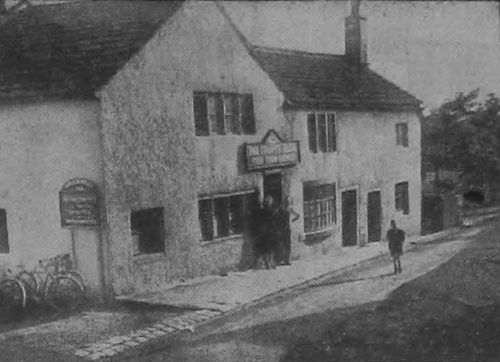
Bull's Head (Tintwistle).
Tintwistle's only free house is the Bull's Head and it's been in the Rowbottom family for close on 200 years. The present owner is Mr. Tom Rowbottom, British Railways signalman living at 83, Manchester-road. He was born at the Bull's Head. And so were his uncle Mr. John Rowbottom in 1872, his aunt Miss Ann Rowbottom in 1869, and his father Mr. Eli Rowbottom in 1867.
The present tenants are Mr. and Mrs. George Garlick. They've only been in nine months but they're hearing all about the olden days from the regular callers, Jack Nichols, Arnold Oldfield, and Albert Shearer. They remember former licensees - Charlie Radcliffe, Bob Garbutt, Peter Johnson, John Dawson, James Chadderton and Ernie Hinchliffe.
Under the sturdy oak beams there's many a tale told of the days when a pint of beer cost 2d. - and a carter's pint was 1½d., when cakes, pipes and matches were there for the taking, and Wakes Monday (in August) was the biggest “do” of the year.
According to local legend, Dick Turpin had “Black Bess” shod in the nearby smithy (now the site of a war memorial). And there's the spot where the stocks once stood, just around the corner. That's how the hill running down to the main road is supposed to have got its name.
Circus animals passing through the village used to call a halt at the stables behind the Bull's Head and Mr. Rowbottom will tell you of the time when an elephant lifted one of the large doors clean off its hinges.
Inside, the Bull's Head is as quaint a place as any tourist would wish to see The low ceilinged rooms and “Curiosity Shop” windows give the old place an atmosphere of peace and tranquillity. The hooks in the tap room are evidence of the days when a flitch of bacon was a common sight.
Long ago, the inn brewed its own beer in the cellar - said to be cut out of solid rock. That would account for the near-constant cool temperature. “There's very little variation and 61 degrees is the highest I've known, even when its been close on 90 outside” said Mr. Garlick.
There were no pumps at the Bull's Head until 1941. Up to then, ale had been drawn from the wood. The old 'uns liked it that way, especially the bandsmen. It's thirsty work in a brass band and the Tintwistle Band had their headquarters there 40 years ago.
When some alterations to the clubroom were necessary, builders found an old jack-knife in a crevice in the wall. How long it had lain there is not known but it's quite possible that the original builders left it.
Apparently, Rowbottoms were not the only people to be born in the inn. Two months ago, a 59-years-old American. Mr. Slater, of Detroit dropped in and told Mr. and Mrs. Garlick that he hadn't set eyes on the old place for 57 years. He was born there but had left when he was two years old, “The place is just the same” he said.
That's what Tom's father must have thought in 1909 when he took over the inn “for a month until he could sell it.” But he stayed there until his death thirty years later. So it looks as though the Rowbottoms are stickers - and maybe the Bull's Head will still be in the family a hundred years hence.