The Rises and Falls of Shepley Mill.


This article attempts to document the ups and downs of Shepley Mill using available records in newspapers and other sources. Any additional information and/or corrections will be gratefully received.

I must acknowledge the help of Lynda Meehan and Mike Brown in preparing this article and for allowing me to use photos from their collections.

Shepley Mill (sometimes referred to as Lower Mill or Lower Whitfield Mill) stood on Chapel Street at the western end of the Green Vale area of Whitfield. After its building the area around the mill also became known as Shepley Mill. The mill was originally built by William Shepley (See A Shepley family of Charlesworth), reputedly in 1784. He left it (“all that my Messuage and Tenement with the Lands and Hereditaments also thereto belonging situate and being near the Bridge end in the said parish of Glossop and known by the name of Shepley Mill”) to his brother Samuel in his will dated 4 February 1796.

The mill was possibly then taken over by James, Joseph and Robert Wagstaff, who (according to Hamnett) built Dinting Mill, and the brick houses adjoining, in 1804 or 1805. They became bankrupt in 1807. Notices of auctions were published in the Manchester Mercury of 1 December 1807:
Sale by Auction by Mr Jacob Goodier. By order of the provisional assignee of the estate of Messrs, James, Joseph, & Robert Wagstaff, bankrupts, at Shepley Mill, near Glossop, in Derbyshire, on the 2d and 3d days of December, 1807;
The following excellent Machinery, consisting of three mules 240 spindles each, 16 inch rollers; ten mules 216 spindles each, 16 inch rollers; one throstle 108, and one do 120 spindles; six carding engines 36 inches each, with working rollers; two stretching frames 108 spindles each, two drawing frames, six heads each; one skeleton roving frame 16 heads, one winding frame, one double cylindered devil, one excellent lathe and tools, with a large quantity of cotton cans, skips, straps, counter, drums, reels, and other utensils.
On Thursday the 3d will be sold, all the Household Goods of James and Joseph Wagstaff - Particulars will be expressed in catalogue, which may be had at the places of sale, and of the auctioneer, 28, Edge-street. Sale to begin each day at ten o'clock.

and in the Manchester Mercury of 22 December 1807:
Sale by Auction by Mr Jacob Goodier. By order of the assignees of Messrs. James, Joseph, and Robert Wagstaff, bankrupts, at Shepley Cotton Mill, situate near Glossop, also at the house adjoining, and at the house of Joseph Wagstaff, at Mottram Longdendale, on Wednesday the 23d December instant,
Two Throstles 108 spindles each, one double cylindered devil, one mule 216 spindles, sixteen inch roller, one winding machine 100 spindles, two counter drums, a quantity of straps and skips, one lathe, spindle head stocks, frame and tools.
Also, all the Houshold Goods, of the said James and Joseph Wagstaff, and one draught horse. Particulars of which will be expressed in Catalogues which may be had at the Auctioneer's, 28, Edge-street.

A further auction, advertised in the Manchester Mercury of 1 November 1808, was held to sell the brothers' beneficial interest in five dwelling houses (plus associated buidings) in Dinting.

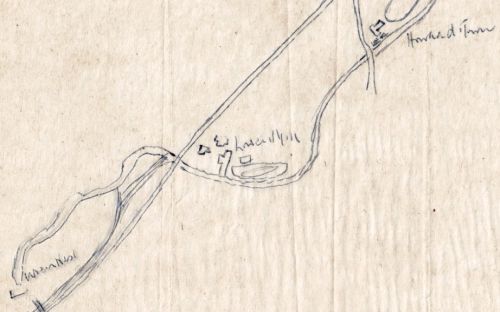
Sketch map showing the relative positions of Wren Nest, Lower and Howardtown Mills about 1815
Sketch map showing the relative positions of Wren Nest, Lower and Howardtown Mills about 1815.


In 1810 the mill was worked by a John Shaw, who was in partnership with John Cooke of Milltown Mill. A notice of dissolution of the partnership, effective on 14 July 1810, was published in the London Gazette of 21 July 1810. John Shaw then apparently extended the mill but subsequently failed, his insolvency being listed in The Law Chronicle of 26 December 1822.

This notice appeared in the Derby Mercury of 26 February 1823:
The Creditors of John Shaw, formerly of Lower Mill, near Glossop, in the County of Derby, and late of Manchester, in the County of Lancaster, Cotton Spinner, who was discharged from His Majesty's Gaol the Castle of Lancaster on or about the 17th day of January last, under and by virtue of Act of Parliament passed in the first year of the Reign of His Present Majesty, “for the Relief of Insolvent Debtors in England,” are requested to meet at the Office of Messrs. Johnson and Lonsdale, Solicitors, in Manchester aforesaid, on Wednesday Fifth day of March next, at eleven o'clock in the forenoon precisely, for the purpose of choosing an Assignee or Assignees for the Estate and Effects of the said John Shaw.

The Manchester Guardian of 21 June 1823 carried this advertisement:
On Friday the 11th day of July next, at five o'clock in the evening, at the Norfolk Arms, near to Glossop, in the county of Derby, subject to conditions then to be produced; All those Two substantially-built Cotton Mills or Factories situate in Whitfield, near to Glossop aforesaid, late in the occupation of John Shaw, but at present untenanted; the old Factory, stone and brick built, being 32 yards long by 10 wide, some part of which Mills is four and the other part three stories high, with an Attic over the whole. The new Factory, wholly stone built, being 20 yards long by 11 wide, is four stories high, besides the Attic. There is a projecting Wing from the centre of the Factories, the lower part whereof is well calculated for Warehousing, and the higher rooms for the receiving of Machinery.
Together with the Boiler, Steam Apparatus and Pipes, for heating the whole of the premises, Shafts, Mill Geering, &c. which are nearly new, and on the most approved principle: excellent Water Wheel, near 18 feet diameter by 9 feet broad, large lodge or reservoir, supplied with a powerful and never failing stream of water, weir goits, privileges, &c .- Also all those Thirteen substantially and part newly built and well tenanted Cottages or Dwelling-Houses, adjoining the said Mills, producing a yearly rent of upwards of £75 and which is capable of considerable increase. - And also all that firmly built Barn, Stable, Cow-House, Pig Sty, and other outbuildings, adjoining the said premises.
The Land, Garden Ground, and Lodge, with the site of the Buildings, comprise about three statute acres, the whole of which is held by Lease from the Duke of Norfolk, to the said John Shaw, for a term of years, of which 17 are unexpired, subject to the payment of £220 per annum. The time for the payment of the purchase-money, will be made easy to a purchaser.
An arrangement has been made with the agent for his Grace the Duke of Norfolk, for an extended Lease for 30 years, from the surrender of the present Lease, by a purchaser, subject to an increased rent of £10 per annum; and he will also have the option of taking a Lease for 14 years, from Lady Day next of 18 acres of Land surrounding the said Mills.
A person will attend upon the premises a few days previous to the sale, to shew them: and any further particulars may be had on application to Mr. Thos. Ellison or Mr. Wood, of Glossop aforesaid; Mr. Samuel Lees, of Manchester, Cotton-merchant; or Messrs. Johnson and Lonsdale, Solicitors, No. 8, Ridge-field, Manchester.


The mill was taken over by Benjamin Rolfe, and it was during his occupation that the incident occurred which prompted William Bennett to write the humorous local poem, “The Flying Serpent” (See The Flying Serpent Hunt, a Story of Shepley Mill). Rolfe was successful, the rate assessment of the mill rising from 4,104 spindles in 1824 to 6,960 spindles, assessed at £90, by the time he left. Rolfe's success came despite a tragic accident which was reported in the Morning Herald (London) of 30 July 1827:
On Wednesday morning se'nnight a number of men employed in the repair of the old part of the Shepley Mill, near Glossop were alarmed by observing certain indications of the mill falling, and immediately left it. One young man, however, who had forgotten his shoes, contrary to the entreaties of his fellow workmen, re-entered the mill, and had scarcely done so, when the building fell, and buried him in the ruins. Assistance was speedily obtained, and he was dug out, but life was quite extinct. When found his head was completely doubled upon his breast, so that he must have died from suffocation, as none of his limbs were broken, nor were there any external marks upon his body which could have produced death. An inquest was held on Thursday, and a verdict of " Accidental Death" returned.
Se'nnight is an old term for a week.

Benjamin Rolfe died on 25 March 1830, aged 63, and the next tenants were brothers John and Robert Barber. They were part of the family that owned Clarke's and Lower Mill at Padfield (See The Barber family of Hilltop and Padfield).
Their tenure was also marred by a serious accident, reported in the Manchester Times of 7 December 1833:On Tuesday night week an accident occurred at the works of Barber, and Co. situate at Shepley Mill, near Glossop. It appears that they had put down a gas apparatus, and that the gasometer had been filled with gas with the intention of lighting up for the first time. On the night mentioned a boy went upon it for the purpose of putting in a screw that had been left out, when the gas escaping through the hole came in contact with the candle which he had in a lantern and exploded. The shock forced the gasometer up on one side so high that the gas escaped from under it and caught fire, blowing it up as high as the top of the supporters, one of which was broken off, and the gasometer falling down on one side was crushed in. The boy was thrown a considerable distance into a brook course, and received such severe injuries on his head that he was insensible all night and was removed to the Manchester Infirmary on the following day.
That gas works, located in Shepley Mill yard, was the first in Glossop to supply the public with gas. It was purchased from Messrs. J.W. and R. Barber by the Duke of Norfolk on 25 May 1840, for £125.
In 1834 the Barbers added 1,980 doublers and when they left in 1840 the assessment was at £137 5s.

The mill was then advertised in several newspapers, for example the Stockport Chronicle of 27 March 1840:
Lower Mill otherwise Shepley Mill, Near Howard Town, Glossop, in the County of Derby.
To Be Let for a Term of Years, as may be agreed upon, (with immediate entry if required).
The above mill, consisting of two good and substantial buildings, of stone, of the following dimensions: The one being 61 ft. 8 in. long by 33 ft. 6 in wide, and four stories in height, and the other 98 ft. 5 in. long by 31 ft. 2 in. wide, three stories in height, with a powerful fall of water upon the Glossop Brook of nearly 16 ft.

Also twelve cottage houses, all well tenanted, realizing upon a very moderate letting the annual rental of £69 17 10d., exclusive of a good and convenient dwelling-house adjoining the same, with barn and outbuildings.
The premises may be accommodated with the convenience of a few acres of Land, lying contiguous thereto, if required.
In the advantages of locality the property altogether is eminently calculated for the favourable application of it to the purposes of spinning or manufacturing cotton, or silk ; or to the processes of calico printing, paper making, or any other business requiring an abundant supply of pure water.
Parties disposed to treat for a Lease of these premises are requested to address their application to Mr. Thomas Ellison, The Hall, Glossop, from whom all requisite particulars may be obtained.
The Hall, Glossop, March 18th, 1840.


The mill, though, was to remain empty for a couple of years. During that time the bottom room of the old mill was used for the Wesleyan Sunday School, which transferred from a room over some stables nearby that had become too small. From August 1841, the room was also used as a chapel but it also quickly became too small, necessitating the building, starting in 1844, of the first Howardtown Wesleyan Chapel on the site of Barber's Lodge, which supplied Shepley Mill with water.

In March 1842 Abraham Jackson, of Storth, Simmondley, took a single room in Shepley Mill before, in stages, renting the whole of the mill by 1850. Abraham Jackson was listed in Bagshaw's 1846 directory, the Post Office 1849 directory and Slater's 1850 directory. On 17 May 1852, the old mill was burned to the ground, only a newer portion being saved, and Mr Jackson suffered a very heavy loss. The mill was rebuilt but was empty when the Post Office directory of 1855 was compiled.

By the time White's directory of 1857 was compiled Shepley Mill had been taken over by John Handforth. He was listed in Slater's and White's 1862 directories and Harrod's 1870 directory.
The mill suffered another fire in 1865, but luckily not so serious. A notice was published in the Glossop Record of 5 August:
Fire at Shepley Mill. Messrs J. Handforth & Sons beg to thank those parties who so willingly assisted to extinguish the fire at their mill, on Wednesday night last, and to assure them that only for their immediate aid, the damage would have been very much greater. Shepley Mill, August 3rd., 1865.

In 1873, John Handforth decided to sell up and the following advertisements appeared in the Hyde and Glossop Weekly News 29 March 1873:
Preliminary Announcement.
Shepley Mill, Glossop. A working concern, consisting of a modern and substantially stone built mill, five storeys high, containing nearly 13,000 mule spindles, with machinery necessary for preparation, all in capital working condition. The plot of land contains nearly 10,000 square yards, at a very low chief, and there are two large dwelling-houses and three cottages producing £71 per annum. There is splendid water power, by means of
which the mill is mainly worked, and the saving of coal alone is estimated at £500 a year.
It is intended to form a public company to take over the concern at once. (See notice of meeting below!) J. B. Kynder, Chapel Hill, Dukinfield. N.B .- The concern will be disposed of at a very low price, and can be obtained a great bargain.

and
Shepley Mill, Glossop. A meeting will be held at the Norfolk Arms, Hyde, on Wednesday evening next, the 2nd April, 1873, at 7.30 o'clock, when a committee of inspection will be appointed, and the fullest particulars given. J. B. Kynder.

No information as to whether the mill actually sold could be found but the decision to set up a limited company to run it went ahead. A notice in the Glossop Times of 10 May 1873 stated:
Shepley Mill Co. (Limited). Notice is hereby given that a Meeting of Intending Shareholders will be held at the Norfolk Arms Hotel, Glossop, on Wednesday next, the 14th instant, at Seven o'clock in the evening punctually, when the fullest information will be given, and the proposed Articles of Association submitted and discussed. By Order, J. E. Lawton, Secretary.

This was followed by an advertisement in the Glossop Chronicle of 17 May 1873:
The Shepley Mill Cotton Spinning Company Limited.
Capital, £20,000; in 4,000 Shares of £5 each.
Deposit on Application, £1 per Share, and on Allotment, £2 per Share.
The Balance will be called up as required, at intervals of not less than One Month, and Fourteen Days' Notice of each Call will be given.
Provisional Directors:
Mr. J. B. Kynder, Chairman of the Dukinfield Hall Cotton Spinning Company Limited, Dukinfield.
Mr. William Leigh, President of the Operative Spinners' Association, Hyde.
Mr. Don John Marler, Director of the Shaw Hall Cotton Spinning Company Limited, Newton Moor.
Mr. George Handforth, Cotton Spinner, Glossop.
Mr. Jacob Hadfield, Iron Merchant, No. 28, Bull's Head Chambers, Market-place, Manchester.
With power to add to their number.
Bankers:
The Manchester and Liverpool District Banking Company, Glossop, and Branches.
Secretary (pro tem.):
Mr. J. E. Lawton, The Shepley Mill, Glossop, Derbyshire.
Offices:
The Shepley Mill, Glossop, Derbyshire.
Prospectus:
This Company is proposed to be formed for the purpose of purchasing and working the valuable Cotton Spinning concern, known as the Shepley Mill, Glossop, Derbyshire. The Mill is situate on the left bank of a tributary of the Etherow, which, a little below, unites with the Goyt, and forms the River Mersey. It is a powerful and never failing stream of water, capable of doing far more than it is now called upon to do, and when coal consumption has become such a considerable item for manufacturing purposes, water power, proportionately, increases in value.
The plot of land contains 9,600 square yards, and about 200 yards more have been made into building land by the filling up of a goit, the whole of which is held under the Duke of Norfolk for the residue of a term of 99 years; about 18 years of which has expired. This lease can, on the usual terms, be converted into one for 999 years. The chief rent is one penny per yard, or £40, and the water rent averages £25 6s. 6d. per annum.
The mill is most substantially built of stone, is five storeys high, and ten windows long one way and three storeys high and four windows long the other way and at present contains nearly thirteen thousand spindles, twist 64-dozens, weft 78-dozens, with all the necessary machinery for preparation.
There is an excellent mechanics' shop, with two lathes, benches, and all the requisite tools for jobbing and fitting up mill work. There is also a capital smithy, fitted up with hearth, bellows, anvil, hammers, swages, &c., &c. There is an excellent condensing beam engine of 40 horse power, by Peel, Williams, and Co., and a steam boiler, in first class condition.
The machinery is mainly turned by water power by turbine, and one of Gunther's turbines, of 60-horse power, with all the latest improvements, is about to be put in, which it is calculated will entirely do all the turning needed. At a very low estimate the saving of coal alone by this means will amount to £500 a year. There are two large and commodious Messuages or Dwellinghouses, and three Cottages, all stone-built, and worth £71 per annum.
With all these advantages, namely, an excellent stone-built Mill, with nearly 13,000 spindles, and machinery for preparation, in full and excellent working condition, the goodwill of a going concern, and a well-established business; two commodious dwelling-houses and three cottages, and ample Room and Power for another Mill and cottages, the greatly improved value of the land, low chief rent, and abundant supply of water, saving in coal at the very lowest £500 sterling a year; the vendors offer the whole at a price which would cost the company about 18s. 6d. a spindle; and will allow a good sum to remain on mortgage at the usual rate of interest; and will take up a large number of shares, or not, just as the company may think fit.
The whole concern can be seen by any one, at any time, and thoroughly inspected.
Applications for shares may be made to the District Bank, Glossop, or at Hyde; or any other branch of the Manchester and Liverpool District Banking Company.

An early application is requested, so that the concern may be taken over as early as possible; and, as it will continue working, there will be no waiting twelve months or so, with shareholders' capital lying comparatively idle. A quick return upon the investment may be safely expected.
Prospectuses, and forms of application for Shares, and any further information, may be obtained at any of the branches of the Bankers of the Company; at the Shepley Mill, Glossop; or at the Estate Offices, Chapel Hill, Dukinfield; and at 18, Bull's Head Chambers, Manchester.
A considerable number of shares are already taken up.


Just over a month later the directors had to quash unhelpful rumours and stated in the Glossop Chronicle 28 June 1873:
The Shepley Mill Cotton Spinning Company Limited. An erroneous impression having get abroad as to the price to be paid for this Concern, the Provisional Directors deem it only fair to the Public and the Proprietors to state that the Total Cost to the Company, of the Mill, Land, Houses, Cottages, Water Power (including new turbine, now being put in), Engines, Boilers, Machinery, and all the effects about the place (excepting only Cotton and Yarn in Stock, and in process of manufacture,) will not exceed £13,000 ; the remaining £7,000 (if called up) will constitute the working capital.

The company suffered a tragedy when the mill again burned down in April 1875. The Glossop Chronicle of 24 April reported:
One of the most alarming and rapidly destructive fires it has ever been our lot to witness occurred in Glossop, on Tuesday morning last.
It may be necessary to explain to readers at a distance that Shepley Bridge Mill stands – or rather stood - at the bottom of Chapel-street, and near the bridge of that name. It is a building five storeys high, and on one side eleven and on the other ten windows long. Abutting on the gable end at the south side is the engine house and storeroom, a building three storeys high, where also the process of mixing the cotton was carried on. The production was limited to yarns, and besides carding and other machinery for preparing cotton the mill contained self-acting mules with over 13,000 spindles.
The site is an excellent one, having an abundant supply of water, and naturally it has been occupied by a mill for a great number of years. Twenty years or more ago a similar disaster to the one we are about to record occurred, the mill then being completely gutted by fire ; the present building was erected on the site 18 or 19 years ago, and since then has been tolerably free from accident. One or two small fires have occurred in the engine house but they were subdued with out serious damage being inflicted; and with water so convenient - the lodge being situated immediately behind, and the stream running past - to outward appearance everything seemed to indicate that the risk of fire was comparatively remote. But disasters like the present come timely to remind us how much progress has been made in recent years even in such matters as the construction of our workshops. Timber is introduced very cautiously into the modern mill, and every care taken, in the event of a fire breaking out, to limit it to the place where it occurs by the introduction of fireproof partitions and divisions. But in the construction of Shepley Mill, timber was largely employed, strong beams being placed in all the walls. The flooring also, had become thoroughly saturated with oil, so that it might be predicted of it as of most other mills after running some time, that if once fire got sure hold the most perfect appliances in the world could not save it.
To the right of the mill are two dwelling houses, one occupied by Mr T. Robinson, Mr Handforth's son-in-law, who for a number of years has managed the concern ; and the other occupied by the Rev. S. Henvil, who only recently has come to take the curacy of Whitfield parish. The end of these houses is only separated from the mill by a narrow cart way ; and on the opposite side the same space intervenes between the mill and the stores of Mr H. Kinder, druggist. On the other side of the street is the Wesley school and chapel. So much for the locality, and now as to the catastrophe.

At half-past six in the morning the machinery was started and the hands - 35 in number - were commencing with their ordinary work, when the terrible cry of “Fire” was raised. The exact locality where the fierce element began its career of destruction has been definitely ascertained, but the cause is not with certainty known. A line shaft ran along the ceiling from the engine to the centre of the ground storey, where it set an upright shaft in motion. The two bevel wheels were protected by a framework of wood, and it was this which ignited first ; caused no doubt by heating from friction. A man is employed for no other purpose than to oil, and he had oiled the two wheels in question shortly before the fire was discovered, noticing nothing wrong. It is thought probable that, a key dropping, the upright shaft may have subsided a little, thus forcing the teeth of the one wheel full into the other. Immediately the workman in the room noticed it he ran to give the alarm, and met Mr T. Robinson. Buckets were in a few seconds brought into active use, but the fire gradually extended in spite of these efforts to master it. Messengers had been hastily sent to Wren Nest and Howardtown mills for the fire engines, and Mr Sumner's was soon on the spot, followed at ten minutes before seven by Messrs Wood's. Matters then wore a very ominous look ; for, although the fire was still confined to the lower storey, the ordinary means of escape for those in the other rooms was cut off by the fire at the foot and the dense smoke ascending the stairs. Alarmed beyond expression at the possibility of an awful fate, some of the hands secured ropes and throwing these through the window slipped down - a dangerous proceeding at the best, but doubly so under excitement. One man let go the rope when only at the second storey, but very fortunately was not much hurt. When a ladder was brought five men were suspended outside in that way. So hurried had been the stampede that many came away without articles of clothing, and one man left a valuable watch in his waistcoat, but fortunately one man, more collected, spying it, brought it off in safety.
The engines were quickly got into position by the edge of the lodge, immediately behind the mill, and so little did they expect the fire to assume the proportions it subsequently did, that both engines were put in places which afterwards became intolerably hot, and they had to be shifted.
Wood's engine was near the engine-house, and Mr Sumner's a little nearer the street. Unfortunately the latter had hardly began to play before it was disabled. The pipe was in a shallow part of the lodge, and it sucked mud as well as water, which choked it up. With two jets Wood's men did their best by playing right in upon the fire, and for a time they were encouraged by the hope of success, and struggled bravely expecting every minute that effective aid would come, either by getting Sumner's into working order, or by the arrival of the Printworks engine. But no such good fortune occurred, and though held in check for a short time, the flames again began to spread, and about half-past seven or a quarter to eight gained foothold in the second story. From this time the progress of the fire was rapid and uncontrollable; a few minutes more saw the next storey in flames, and at eight o'clock the whole building was in full blaze, forming a spectacle of grandeur and dread which may not be seen again in a lifetime. The heat was so intense that the surrounding buildings already indicated began to ignite in the roof. The furniture in tho two dwelling-houses was rapidly and it is to be feared rather ruthlessly removed ; and one of the jets bad to be brought into play upon the roof at the end next the blazing mill, which was smoking and ready to burst into flames. The spouting, indeed, had caught, and the wood work under the slates, but this was quickly extinguished. Some of the furniture had to be brought through a front window, and it is wonderful bow the men stood the beat, considering that some of the articles were blistered by it. The Wesley School was also showing dangerous symptoms, but this was extinguished by buckets of water carried on to the roof.
To save the engine and mixing room a steady stream was poured into the mill against the wall next the engine house. These efforts were happily successful. About a quarter past eight the roof fell in, but here and there some sturdy beam on the top floor sustained a mass of flaming rubbish, while lower down the main beams still stretched across the seething furnace, and blazing logs might be seen descending, caught at one moment by some piping and the nest swaying upon one of the beams, while flames shot out furiously from the windows – or say rather the places where windows had been. Then the strong oak logs above the windows were blazing too, and as these began to give way and stones fell the work of the firemen became more dangerous. One large stone came down with a crash so near to Mr S. Wylde, that to all appearance an inch would have deprived the world of some excellent comic songs; but he stuck to the hose, and continued to toil with as much coolness as if nothing had happened to disturb his serenity. The greatest danger arose from the contiguity of Mr Kinder's premises, where were stored a quantity of highly inflammable substances; but these had been removed on the first appearance of danger, and the outhouse next the mill was deluged by a jet whenever smoke was seen issuing
from it.
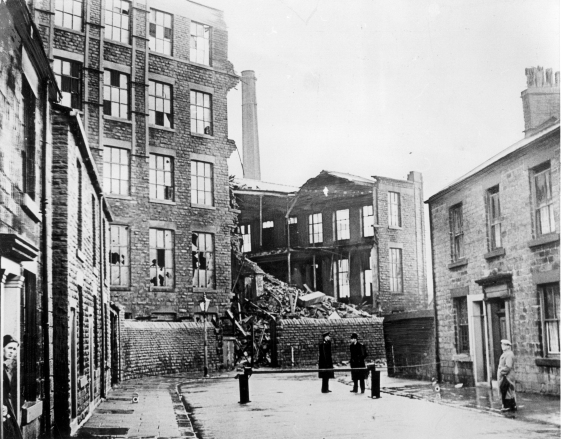
A mounted messenger had been set tor the Printworks engine, and it arrived about eight o'clock, and about half-an hour after that Sumner's engine again began. The only thing possible then was to confine the area of disaster to the principal building. The fire was first got under at the end next the engine house; and from thence the men advanced gradually until the street wall was reached. Fears had all along been entertained that the walls would fall, and about noon that next the dwelling-house did come down. The other engines had then left, Mr Sumner's men being the first on the ground having the honour of staying till the last. Just before the wall gave way they were at the bottom of it with the hose, but PC Goldstraw standing at the end saw it bulging out, and shouted in time for them to draw back. At night the other side wall was pulled down, and the wall next the street has since been removed, to prevent the possibility of accident. Some bales of cotton, removed from the premises, were placed at the end of the street as a kind of barricade, and behind this several members of the police force stood keeping back the curious crowd; afterwards the
street was railed off at either end, and traffic absolutely stopped. So many tradesmen and others worked energetically that it is impossible to name all, and to specify a few would be invidious ; suffice it to say that everyone from the Chief Constable to the policeman, and from the manufacturer to the half-timer, was ready to give help where help was needed. Specially do the men connected with Messrs Wood's mill deserve praise, for the brunt of the battle fell to them, and they put forth every effort. They have confidence, also, in their engine now ; it has recently been repaired, and made much more powerful and effective.
The amount of damage is estimated at fully £10,000, and we regret to add that the half of this amount, and even more, is a direct loss to the firm, the portion of the concern consumed being only insured for about £4,000. There was cotton in process to the value of £500. Several hundred pounds worth of new machinery had been put down within the last twelve months, and we believe at no time was it in better working order, more yarn having been turned out, with short hours, in the fortnight preceding the fire than in any similar period for many years past.


This advertisement was also published in that edition of the newspaper:
The fire at Shepley Mill. J. Handforth & Son return their sincere thanks to the Captains and Members of the three Fire Brigades, and others, who so willingly gave their assistance during the Fire on Tuesday.

Following the fire a decision was made to try to float a limited company again. The Glossop Chronicle of 17 July 1875 published this advertisement:
The Shepley Mill Cotton Manufacturing Company Limited.
Capital £60,000, in 12,000 Shares of £5 each.
Deposit on application, 2s. 6d., per Share, and 7s 6d. on Allotment; the remainder to be called up as required, in Calls of 10s per Share, of which 28 days' notice will be given,
Provisional Directors:
Joseph Stafford, Cotton Spinner, Glossop.
Edward Partington (Olive & Partington), Turn Lee Paper Mills, Glossop.
William Platt, Cotton Manufacturer, Hadfield.
John Armitage, Coal Merchant, Glossop.
Cephas Ernill, engineer, Glossop,
William Thorpe, Bookkeeper, Glossop.
Eli Downs, Gentleman, Glossop.

Joseph Buckley, Manager, Glossop.
(With power to add to their number.)
Bankers: The Manchester and Liverpool District Banking Company at Glossop, or any of
its Branches.
Secretary (pro tem): Thomas Robinson, Shepley Mill, Glossop.
Office: Shepley Mill.
Prospectus:
This Company is formed for the purpose of purchasing, rebuilding, extending, and working the Valuable Cotton Spinning Mill, known as the Shepley Mill, Glossop, Derbyshire, which has been partially destroyed by fire.
The property consists of a plot of land above two acres in extent (9,950 square yards), which is held under Lord Howard of Glossop, for the residue of a term of 99 years, about 19 of which have expired. The Lease can, on the usual terms, be converted into one for 999 years.
The Chief rent is under one penny per yard, and the water rent averages £25 5s. 6d, per annum.
The Mill is situated on the left bank of a tributary of the Etherow.
The property is very near the Glossop Railway Station, and in the midst of an abundant supply of labour, being situated between two other large mills employing from 2,000 to 8,000 hands each.
There is a well built mechanics' shop, with two lathes, benches, and all requisite tools for jobbing, and fitting mill work ; also a capital smithy fitted up with bench, bellows, anvil. hammer, swages, &c.
The motive power consists of a condensing beam engine of 36-horse power, by Peel, Williams & Co., driven by a nearly new steam boiler working at a pressure of 60 lbs per square inch, which have been valued at selling-out prices.
A turbine of 80-horse power, by Gunther, with latest improvements, has recently been erected, thereby securing great economy in fuel.
There are three well-built cottages of stone and two dwelling houses. It is purposed to erect a mill to contain about 30,000 spindles, and a weaving shed for 600 looms. The mill and machinery will be of the newest and most modern construction in both the spinning and weaving departments, thus securing all the advantages of a model concern.
The whole property has been valued by Mr. Joseph Leech, of Ashton and Manchester, at £5,212 2s 10d
Mr. John Handforth, the Vendor, has agreed to accept the low price of £4,000 for the property as it stands, and to receive the purchase money as follows, namely, £2,000 in fully paid up shares, and the remaining £2,000 in cash.

A considerable number of shares are already taken up.
Prospectuses and forms of application for shares may be obtained from the Manchester and Liverpool District Banking Company, at Glossop, Oldham, Hyde, Ashton, Stalybridge, and Branches; or from Mr. Thomas Robinson, Shepley Mill, Glossop.


Thomas Robinson, who was named as the company secretary, was the son of William Robinson who had worked Warth Mill before becoming manager at Wren Nest (See The Robinsons of Gnat Hole) and the son in law of John Handforth.

Further advertisements in the Glossop Chronicle of 9 October 1875 stated:
The Shepley Mill Cotton Manufacturing Co., Ltd. Interest will be allowed on calls at the rate of £5 per cent. per annum until the Mill commences work if no allotment is made the deposit money will be returned in full without interest. Prospectuses and Forms of Application, may be obtained from the Manchester and Liverpool District Bank, or from Thomas Robinson, Shepley Mill. The Share List will close on the 23rd of October.
and in the Glossop Chronicle 8 July 1876:
The Shepley Mill Cotton Manufacturing Company Limited. The share list of the above Company is now re opened. Prospectuses and forms of application may be obtained from the Manchester and Liverpool District Banking Company, Glossop, or from Mr. Thomas Robinson, Shepley Mill, Glossop. The Directors are also prepared to receive Loans, at 5 per cent per annum.

John Handforth had been listed in the Post Office directory 1876 as a cotton spinner of Chapel Street but the mill was not named.

The Hyde and Glossop Weekly News of 2 June 1877 reported on progress:
On Wednesday evening the ordinary half-yearly general meeting of the shareholders of the Shepley Mill Cotton Manufacturing Company, Limited, was held in the Wesley Day School-room, Chapel-street. There was a good attendance, especially considering the unfavourable state of the weather. Mr. Joseph Stafford, J.P., occupied the chair. The first business was the confirming of the minutes of the last general meeting. The following report was read by Mr. Thomas Robinson : “Herewith we beg to hand you the report and statement of receipts and payments for the half-year ending April 30th, 1877. Your directors beg to state that the contracts for engines, gearing, &c. are let. An offer has been made to, and accepted by, Messrs. Asa, Lees, and Co., Limited, Oldham, for the whole of the machinery for the mill, subject to detailed specifications. They also beg to say that they are urging the contractors to expedite the completion of their respective contracts.” Then followed the account of receipts and expenditure. After several questions had been asked and answered, Mr. Shallcross proposed that the report be adopted, and the accounts passed. Mr. Cox seconded, and the resolution was unanimously carried. The Chairman said he did not know that he need make any remarks. Now they had passed the report and adopted the accounts, he might tell them that they had every prospect of having a good mill and a cheap mill, and such a mill as perhaps there was not in that dale, and no better in any other dale.

And on 9 February 1878:
It may be consolation to some to know that if one mill is burnt down another can soon be ready for working. We refer to Shepley Mill, which is a very handsome structure indeed. No machinery has yet been placed in the mill, but it is almost if not quite ready for those operations.

The Glossop Chronicle reported on further progress on 19 October 1878:
An extraordinary general meeting of the shareholders of the Shepley Mill Cotton Manufacturing Co., Limited, was held in Wesley school-room on Wednesday evening. There was a good attendance, and Mr. J. Stafford, president of the Board of Directors, occupied the chair. The report of the Directors was read, and a statement of accounts laid before the meeting. The following resolution was then carried unanimously :- “That the report of the Directors just read to this meeting of shareholders be approved and accepted; and that all the actions of the Directors in the management of the affairs and business of the company be adopted, approved, and confirmed.”
A discussion arose as to the loan holders being covered, which resulted in this resolution being put to the meeting, “That this meeting authorise the notice of 3,000 preference shares at £5 each, to rank first for 2 dividend at the rate of 7½ per cent.”
This was unanimously carried, and one of the shareholders was pressing for those precent at once to state how many shares they would take up, but it was decided that this should be done by circular in the usual way, and it was also intimated that the shares not taken up by shareholders would be offered to the public.
The Chairman said he had one other matter to lay before them. As the mill was almost ready for working, he would suggest to them that they allowed the interest in the share capital to cease. A resolution had been passed that it must cease as soon as the machinery turned round, and they could do that to-morrow. The matter was in their hands, and they could do just as they liked. The times now were very extraordinary, and there was a cloud hanging over the cotton trade, but they all believed that it would not always be so.
A Shareholder got up and proposed that the interest cease accordingly.
This was seconded, but Mr. C. Garside said he should make an amendment, as he thought it would be time enough for the interest to cease when the mill was earning something. But when it was explained that the turning of the shafting would stop the interest, he withdrew his amendment, and the following resolution was carried, “That the
interest in the share capital shall cease from October 31st until the same has been raised by the successful working of the mill.
A very good feeling seemed to pervade the meeting; all passed off amicably, and a hearty vote of thanks to the Chairman closed the proceedings. The above scarcely needs any comment. The first resolution shows unbounded confidence in the Directors; the second shows not only a desire to preserve the loan holders from all risk, but absolutely cover them by the time of the preference shares ; the third resolution shows that the shareholders have confidence in the ultimate success of their undertaking, as they are willing to suspend their interest until the mill is earning it. We fully expect to see Shepley Mill one of the most profitable concerns of its kind.

The company was still trying to raise money, though, and advertised in the Glossop Chronicle of 30 November 1878:
The Shepley Mill Cotton Manufacturing Company Limited. New Issue of Preference Shares of Five Pounds each, to rank first for dividends at the rate of Seven and a Half per centum per annum. The Directors are now prepared to receive applications for the above. Thomas Robinson, Secretary.

The following year the Hyde and Glossop Weekly News reported again. On 15 February 1879:
On Monday evening last an extraordinary general meeting of the shareholders of the Shepley Mill Cotton Manufacturing Co., Limited, was held in a large room in the mill. The meeting was called for the purpose of considering the state of the share capital of the Company; also to receive the directors' report of their progress and operations; and to take into consideration the passing of resolutions as to increasing the share capital, or otherwise raising additional funds for carrying on the Company's operations. There was a very good attendance, and after a lengthy discussion the meeting was adjourned for a week without any resolutions having been passed. As regards building, the mill is finished, and is a very handsome structure indeed. It is also partially filled with machinery, which is of the most improved kind, and we trust that before long the state of trade will be such that the mill can commence working. It is expected that once started the concern will be a profitable one, as it possesses many advantages, and is of the most modern kind in every respect, We wish it success.

and on 22 February 1879:
The adjourned meeting of the shareholders of the Shepley Mill Cotton Spinning Company, Limited, was held in the mill on Monday evening last. There was a very good attendance, and the chair was occupied by Mr. J. Stafford, president of the board of directors. A resolution was passed unanimously to the effect that 6,000 preference shares should be issued, to rank first for dividend at the rate of 12½ per cent. It was intimated at the meeting that the Shepley Mill Co. had fewer shares taken up for the size of the concern than any other company in existence. This being so, it became a necessity to issue further shares, and to offer an inducement to the present shareholders, the above resolution was passed.

The share issue consequent on the resolution was advertised in the Glossop Chronicle of 22 March 1879:
The Shepley Mill Cotton Manufacturing Company Limited. Issue of 6000 Preference Shares of Five Pounds each, to rank first for dividends at the rate of Twelve Pounds Ten Shillings per centum per annum. The residue of the above are now offered to the public. Forms of application for shares may be had at the M. & L. D. Bank, Glossop; or from Thos. Robinson, Shepley Mill.

The company appears to have continued to face some difficulty, though, as a report in the Glossop Chronicle of 12 April 1879 stated:
We are extremely sorry that there seems to be a cloud at present hanging over the Shepley Mill Cotton Spinning Company, Limited. It is a pity that things are now at a standstill, for if the mill could but once commence operations there is every reason to believe that success would ultimately be the result. As regards the mill itself there is everything in its favour, it is a fine structure, built in the most modern style, the machinery too is of the very best, possessing all the most recent improvements, and as such ought to make its mark in the commercial world. If this be so, the question may be asked, why is it not a success? We cannot give details on this point, as we are not in the secrets of the Directorate, but, speaking broadly, we may say that it is quite understood that it is not the fault of the Directors, for these are all men who have been selected fer their sagacity in business matters, and if they had been assisted by the public, as we contend they ought to have been, the Shepley Mill Company would not have been in its present circumstances. With increased labour in the town there would be more cash to be disposed of, and the shopkeepers would have had the benefit of it. Then why would not they do something! We have heard more than one shopkeeper say that if the mill did commence it would not be much benefit to them, as the people would go to the Co-op. This perhaps is too narrow a view to take of the question, and at any rate we think that the people of Glossop might, if they had liked, and much to their advantage, have made the undertaking a profitable and complete success. The real fault lies in the fact that only a small portion of the share capital has been taken up. The Directors have recently made an effort to get more shares taken up by offering preference shares to rank first for dividend ; these have not been taken up in the hearty manner that was expected, and, under these circumstances, we understand that the Directors have sent in their resignation. What will be the ultimate fate of Shepley Mill we cannot say, but it has our hearty wishes for its success.

More hopefully, the Glossop Chronicle of 26 April 1879 reported:
The “turn of the tide” is sure to come, and we believe there are better days in store for the Shepley Mill Cotton Spinning Company. The other week we had occasion to refer to this company, and nothing more need be said as to its general purpose, but it may be well to mention, for the information of those holding shares at present, and some who have hitherto held back to see which way the wind was blowing, that there is every evidence of renewed interest being taken in the concern, and if this be the case the company will soon find its level. We hear of one gentleman, a shrewd man of business, and one who would not speculate if he did not see good prospect of return, promising to invest in a large quantity of preference shares, and several tradesmen are beginning to manifest an interest in the concern which has hitherto been wanting. From these and other reasons there is every cause to believe that the company will soon be placed in a good commercial position, and there is no denying that it would be a great advantage to the town and neighbourhood.

And then on 10 May 1879:
We heard it stated that Shepley Mill will be running in the course of the next three months, and there appears good grounds for the statement. The preference shares within the last few weeks have gone up considerably in public favour, and the wonder is that shareholders could not have seen in what direction their benefit lay earlier. One gentleman has backed his old shares to the tune of £56,000, and others have followed his example so far as lay in their power, whilst he has also offered to remove a tangible load from the shoulders of the Directors. All the old Directors are again in office with the exception of Mr. Platt, in whose place Mr. James Rowbottom has been elected. After the allotment of the shares there will be no great difficulty in the way of the Directors, and we very soon hope to have this model concern busily employed in our midst.

The cotton industry was, at the time, facing problems so the company still required funding and advertised in the Glossop Chronicle of 7 February 1880:
The Shepley Mill Cotton Manufacturing Co., Ltd. Loans may now be deposited with the above Company. Thos. Robinson, Secretary.

Shortly afterwards, though, the Hyde and Glossop Weekly News of 28 February 1880 was able to report:
The Shepley Mill - We are glad to see signs of this mill commencing work, the new machinery having been put in very quickly since trade revived, and on Wednesday the first load of cotton was taken to the mill, which it is expected will commence working on Monday. The preference shares of the Shepley Mill Cotton Manufacturing Co. are worth in the market £1 premium.

And on 13 March 1880:
There are unmistakable signs of the trade of the Glossop district improving. At the newly-built Shepley Mills small loads of cotton have arrived, and it is expected that in a short time this concern will also be in full work.

Further good news came in the Hyde and Glossop Weekly News of 21 May 1881:
Our Glossop correspondent says that Shepley Mill, in that town, has long been under a cloud, but he is thankful now to state that the cloud is dispersing, and that brighter days are dawning. From the report of the directors for the half year just past it appears that there has been a gain of £1,104, which, with the balance of £407 14s. 11d. from the previous half-year, makes a total gain for the year of £1,511 14s 11½d., out of which they recommend a dividend of 12½ per cent on the paid-up calls of the preference share capital, and 2½ per cent on the paid-up calls of the original share capital, leaving a balance in hand of £93 6s. 7½d. Our correspondent may well say, “Well done, Shepley Mill.”.

Within a few years Thomas Robinson decided to retire. The Glossop Chronicle of 1 August 1885 reported:
We understand that at a meeting of the Directors of the Shepley Mill Spinning Company Limited, Glossop, held on Monday evening, Mr. Alderman Stafford was appointed managing director, in the place of Mr. T. Robinson, who has resigned. Mr. Robinson has hitherto held the combined position of manager and secretary, but under the new arrangement the secretarial duties will be deputed to Mr. A. Dearnally, and the management will be entrusted to Alderman Stafford. There were two candidates for the position of managing director, these being Mr. Alderman Stafford and Mr. A Baxter, the former as we have previously stated, being selected.

Unfortunately there was a further setback shortly afterwards. The Glossop Chronicle of 3 October 1885 reported:
Just after the engine at the mill of the Shepley Mill Spinning Company, Glossop, was started this (Friday) morning a serious accident occurred. Both ends of the cylinder of the engine were forced out, and the engineer (Mr. Cephas Ernill, jun.) narrowly escaped injury. The mishap fortunately will not necessitate the stoppage of operations at the mill, as another engine is available, and the hands will work in relays.

The company then decided to formalise the secretarial position, advertising in the Glossop Chronicle of 24 October 1885:
Wanted, Secretary to the Shepley Mill Co., Limited, Glossop. Application (by letter only,) not later than Tuesday, the 27th inst., with testimonials and salary expected, and when the duties can be entered upon, to be made to the Directors.
A Mr. George Roberts was apparently appointed, as he was listed as Secretary in Kelly's directory of 1888. Abel Dearnaley, who only reached the age of 24 on 31 October, returned to his previous duties under Alderman Stafford.

Despite continuing difficult trading conditions, the Glossop Chronicle of 20 November 1886 was able to report:
On Wednesday night, the ordinary half-yearly meeting of shareholders of the Shepley Mill Cotton Manufacturing Company Limited, Glossop, was held on the company's premises. The capital of the company is £90,000 in 12,000 original and 6,000 preference shares of £5 each. The report and balance-sheet for the half-year ending 24th April, 1886, was submitted and adopted. The directors in their report state as follows : “Although the cotton trade is still in a very depressed condition, and gives little hope of immediate improvement, we are glad to state that, after taking off the usual depreciation, £969, recouping the loss of £75 11s. 0½d. on the last half-year, and providing for the loan interest, there remains a balance to profit of £711 3s. 9½d., which we recommend you to distribute in the following manner, viz., 2s. 4d. a share on the 12½ per cent preference shares, which will take the sum of £700, leaving a balance of £11 3s. 91½d. to be carried forward to next half-year's account . Mr. S. Rowbottom was re-elected on the Board of directors. There was a fair attendance of shareholders present.

Progress continued to be good, the Hyde and Glossop Weekly News of 4 May 1889 reporting:
The Shepley Mill Spinning Company, Limited. - The half-yearly report of the above company has just been issued, and it shows a profit, after allowing for depreciation and loan interest, of £1,336 3s. 5d., added to which is the sum of £1 5s. 6½d. from last half-year, making a disposable balance of £1,337 8s. 11½d., which will allow a dividend of 4s. 5d. per share on the 12½ per cent preference shares of £5 each, and the balance of £12 8s. 11½d. to be carried forward to next half year's account.

A change of management was then forced upon the company. A report in the Glossop Chronicle of 21 February 21 1890 stated:
Yesterday Mr. Abel Dearnaley was appointed manager of the Shepley Mill Spinning Co. in succession to Ald. Stafford, who is resigning owing to ill-health.
and a fortnight later:
Presentation to Alderman J. Stafford. Tomorrow (Saturday) evening, Alderman Jos. Stafford will be presented with a beautiful marble timepiece by the employees of the Shepley Mill Spinning Company, Limited, as a mark of the esteem in which he has been held during his connection, which he has just severed with the above company. The timepiece, which is of a new design, has been on view during this week in the shop window of Mr. George Swan, watchmaker and jeweller, “Under the clock”, 238, High-street West, by whom it has been supplied. It bears a silver plate with the following inscription :- Presented to Alderman J. Stafford. J.P., by the employees of the Shepley Mill Spinning Company, Glossop, as a token of esteem. March 8th, 1890.

The cotton industry was also beset by labour problems during the latter years of the 19th century. The Cotton Factory Times reported on 14 April 1893:
Now that the cotton struggle is ended Glossop assumes its natural aspect, as all the mills are working full time. Most of the mills observed Friday and Saturday last for Easter Holidays, but Shepley Spinning Co. only stopped Friday. No doubt this firm was very anxious to recoup itself a little from the heavy losses it has sustained through being closed during the cotton dispute.

Two years later the mill suffered another fire, but not as disastrous as that of 1875. The Glossop Chronicle of 7 June 1895 reported:
Considerable alarm and excitement was occasioned at Glossop, on Saturday morning, by the bare announcement that Shepley Mill was on fire, and the appearance of the Glossop Fire Engine as it sped along the street caused a large crowd to collect. Vivid was the recollection in the memory of some, of the large conflagration which consumed the old building, the site of which is now occupied by the present structure, the rooms of which it is stated are comparatively fireproof. The fire appears to have originated in a room wherein are the large wheels and pulleys of the engine, round which the rope drives run. One rumour is that the ropes were ignited owing to friction, but whether this is correct or not we cannot say. Others state that the cotton dust which flies about became ignited by some means and set fire to this portion of the building. When the fire was discovered the works were stopped and every effort was made to subdue the flames. An able staff of workers, under the guidance of Mr. A. Dearnaley, endeavoured to put out the flames which by this had got a good hold. Their efforts being in vain a message was despatched for the Borough Fire Engine. Information was received at the Police Office at 9:33, and within ten minutes the engine, with a good complement of firemen and police were on the scene, and within a very short time had the hose pipes affixed to the hydrants and were playing upon the burning structure. Mr. W. H. Hodgson was in charge and the following firemen and police officers acted promptly to the call : Messrs. Depledge, Shaw, Hall, and Wolstencroft ; with Sergt. Chapman, Sergt. Hadfeld, Acting-sergt. Davidson, and Constables Bradwell, Whittaker, and Walton. Assistance was also rendered by the fire brigade and engine from Messrs. F. Sumner's. After about fifteen minutes' exertions on the united parts of the fire brigades the flames were got under. At 10.40 the Borough Fire Engine and men returned to the Police Station. During the excitement a lad named Larkin got slightly hurt. One of the cotton chambers was filled with smoke and it was feared that the fire would spread to here, but fortunately this was obviated. The damage done is somewhat extensive, the rope drives being burnt (which has necessitated a stoppage of the hands), and the room and machinery greatly damaged.

Happily the Cotton Factory Times was able to report on 21 June 1895:
The workpeople of Shepley Mill Spinning Company commenced work on Thursday morning week, after being stopped nearly a fortnight through the late fire

Sadly this was followed by more bad news. A report in the Cotton Factory Times of 11 October 1895 stated:
The cotton trade in Glossop is still under a depression. Shepley Mill and Hurst Mills are still stopped, whilst Mersey Mills and Brookfield Mills are only working broken time. The breakdown repairs at Sumner's having been completed, work was resumed last week after a stoppage of six weeks. Jno. Wood Bros. are working full time, and are likely for doing so this winter, as things have greatly changed for the better. A number of people who work at Messrs. Sumner and Co. have been in sore straits for money this year owing to the stoppages through breakdowns. All the engines have now been repaired, and it is hoped the firm will push ahead during the winter.

The company managed to survive the various crises, including a fire in the blowing hole on 5 December 1898, and some years later the directors decided that it would be appropriate to reduce the company capitalisation. An advertisement in the Glossop Chronicle of 26 April 1901 stated:
In the Matter of the Shepley Mill Cotton Manufacturing Company, Limited, and Reduced; And in the Matter of the Companies' Act, 1867 And in the Matter of the Companies Act, 1877. Notice is hereby given that a Petition for confirming a resolution reducing the capital of the above Company from £90,000 to £69,436 was on the 16th day of April, 1901, presented to the Chancery Division of the High Court of Justice, Manchester District Registry, and is now pending; and that the List of Creditors of the Company is to be made out as for the 7th day of May, 1901.
Theo. Walter Ellison, Norfolk Chambers, Glossop, Solicitor to the Company.


The company was able to turn a profit for a few years, for example the Glossop Chronicle reporting on 2 May 1902:
Shepley Mill Cotton Manufacturing Co., Ltd. The Directors Report states that after bringing the profit of the half year into the account, there is a balance of £1,667 17s 4d. Out of this they recommend that a dividend of 6d per share, being at the rate of 5 per cent per annum be paid.
on 5 May 1905:
Shepley Mill Co., Ltd., Glossop. In their report for the half-year ending April 29th the directors state that after allowing £600 for depreciation, there is a profit of £2,148 1s. 7d., which with £29 0s. 8d. brought from last half-year, leaves a credit balance of £2,177 2s. 3d., out of which they recommend a dividend of 1s. per share, being at the rate of 10 per cent per annum, absorbing £1,382 ls., and carrying the balance of £796 1s. 3d. forward.
and on 2 November 1906:
Shepley Mill Cotton Manufacturing Co. In their report for the past half year the directors state :- After allowing £600 for depreciation, there is a profit of £1,083 4s. 0d., which, with £1,870 14s. 4d. brought from last year, leaves a credit balance of £2,953 18s. 4d., out of which we recommend a dividend of one 1s. per share, being at the rate of 10 per cent. per annum, absorbing £1,382 1s. 0d., and carrying a balance of £1,571 17s. 4d. Forward.

Unfortunately the good times did not last and parts of the mill became unused. On 30 July 1909 the Chronicle reported on the fashion for opening roller skating rinks (The Rinking Rage) and the fact that three were proposed for Glossop. One of the people involved was Sydney Spenser, owner of the Theatre Royal in Victoria Street (See <A HREF="./glh010.htm" target="new window">Glossop's Theatres and Cinemas</a>), who had made an application to the local Justices concerning his new venture. Earlier on in the summer Mr. Spenser had announced that he would provide a rink in Glossop, and it appeared that his idea would very shortly see consummation. He had completed arrangements with the directors of Shepley Mills, Chapel Street, to acquire on lease their weaving shed, which for some time past has been used as a “conditioning” shed, and to transform the building into an up-to-date rink. The rink went ahead, as did others in the town, but the “Rage” did not last long.

Thomas Robinson, for so long a mainstay of the company, died on 27 August 1911. The Chronicle of 1 September carried this obituary:
Former Well-known Glossop Gentleman's Death.
Mr Thomas Robinson of Old Colwyn.
By a host of Glossopians there has been received with deep regret news of the death of Mr. Thomas Robinson, of Glengarry, Old Colwyn, which took place on August 27th, after a brief illness. The deceased gentleman, who was 75 years of age, had resided at Old Colwyn for a period of over twenty years. Previous to leaving for the Welsh seaside resort, he was a resident of Princess Street, Glossop, and one of the best known and most respected men in the town. His wife predeceased him about three years ago, and he leaves no family. The deceased gentleman had recently much enjoyed a visit to his
Glossop friends, and had stayed for over a fortnight with his niece, Mrs, Alfred Phillips, of Pikes Lane. During his stay he visited a great many of his old friends and acquaintances, and appeared to thoroughly enjoy himself, indeed he stated that he never had a more pleasurable outing to the “old place” than his last visit proved to be, and it had been his delight to meet old friends and compare with them interesting reminiscences of the past. He left Glossop on the Thursday at noon prior to his death on Sunday, and was compacted to Manchester Exchange Station by Mr. Phillips, to whom he expressed the great pleasure which his visit to Glossop had given him. News of his death accordingly came as a great shock to those amongst whom he so recently sojourned, but for some time past he had suffered from heart weakness. In his boyhood days the deceased gentleman was apprenticed to the grocery business in Dukinfield, and during the Cotton Panic he kept a large and up-to-date grocery business at premises now occupied by Messrs. T. Hadfeld and Sons, the Bon Marche, Glossop, afterwards becoming connected with the local cotton industry. For a considerable period he and his father-in-law, the late Mr. J. Handforth, were connected with the old Shepley Mill, to which they belonged, and which stood on the site of the present mill, and was burned down over thirty years ago. The deceased gentleman's father, Mr. William Robinson, it will be well remembered, was for a long period – over forty years - head manager for Mr. F. J. Sumner, Wren Nest Mills, Glossop, prior to which he was engaged in the cotton industry at Old Glossop, and could be regarded as one of the pioneers of the cotton industry in the town. When residing in Glossop the late Mr. Thomas Robinson was actively identified with Wesley Chapel and Sunday School, as was also his father, the latter being connected with the building of the present Wesley chapel. A few years ago deceased generously gave a sum of £200 towards clearing off the debt on Wesley Chapel. At Old Colwyn the deceased gentleman was also prominently connected with the Wesleyan cause and took an earnest and practical part in the various Wesleyan movements carried on there. He was a man of pleasant and urbane manner, was held in the highest respect by all who knew him, and at both Glossop and Old Colwyn his kindly personality will long be held in pleasant remembrance. The interment took place on Tuesday, and was numerously attended, a special service being held in the Old Colwyn Wesleyan Chapel. The friends present from Glossop included Mr. and Mrs. A. Phillips, Miss Hadfield, of Cowbrook; and Mr. H. Fielding and Mr. A. Dearnaley representing the Glossop Wesleyans.

The state of the cotton industry continued to fluctuate but there was enough optimism for the managers to commit to the building of a new engine house, the plans of which were approved by the town council on 4 September 1912. The execution of the plans was not, however, without problems, the Glossop Chronicle of 29 August 1913 reporting:
When the workpeople employed by the Shepley Mill Spinning Co. left off work for the holidays, the week-end prior to the Wakes week, they were aware that a new engine was to be installed by the firm. However, they were told that the factory would re-open on the Monday after the holidays. But on the operatives making enquiries subsequently, the work going on in the engine room was found to be unfinished, and they were informed that work would not be resumed for at least another week after the Monday expected. In consequence the workpeople have had an additional week of comparative idleness.

The industry continued to suffer and, eventually, the directors had to close the mill temporarily. The Cotton Factory Times of 8 July 1932 reported:
A meeting is to take place with the directors of Shepley Mills, Glossop. The operatives are hoping for good news. It is just over 12 months since this fine mill closed down.
But then on 26 May 1933:
Shepley Mill has been stopped nearly three years.

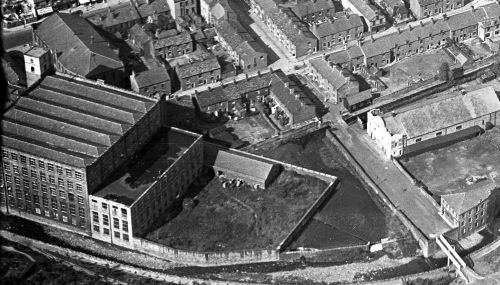
Aerial view about 1933 showing, Shepley Mill bottom left with the Big Wesley above and the Electric Palace, George Street footbridge and Gloveworks to the right
Aerial view about 1933 showing, Shepley Mill bottom left with the Big Wesley above and the Electric Palace, George Street footbridge and Gloveworks to the right.


Better news came the following year. A report in the Cotton Factory Times of 13 July 1934 stated:
The good news spread throughout Glossop last week that Shepley Mill is to be re-started after being stopped for many years. The mill is a fine modern stone building equipped with up-to-date spinning and carding machinery. Already labour has been engaged to clean the machines, which have been attended to from time to time, so that the task of getting ready for a quick start has been made easier.
and on 8 August 1934:
The starting of Shepley Mill has been a blessing to many spinners and cardroom operatives in Glossop, and this, in conjunction with the starting of part of the iron foundry in another part of the town, has helped to lessen the amount of unemployment. Matters are so bad that tradespeople are selling up and property cannot be sold.

The restart came at a cost to the labour force, however. The Cotton Factory Times of 21 September 1934 reported:
The conditions of labour employed at Shepley Mills have caused widespread dissatisfaction throughout the borough. The Glossop and Hadfield Trades Council had the question before them last week. Discussion centred over the conditions of employment introduced by the directors responsible for running Shepley Mill. One delegate reported that the firm were offering married men a wage of 15s. a week, and the firm intended starting work at 6 a.m., thus reverting to pre-war conditions.
The Trades Council passed the following resolution :- "That this Council deplores the action of those responsible for the working of Shepley Mill in offering wages which are below subsistence level and the bringing in of the hours of working to those which appertained in pre-war days."
Copies of this resolution have been sent to the directors of the company and to the secretaries of the local branches of the textile union.
Already on the Hadfield side one firm is working on pre-war hours and conditions of labour, evidently taking advantage because there is such a large number of cotton operatives unemployed. Owing to their economic conditions they were compelled to accept the terms offered.
The fact that there are such great numbers of cotton operatives without work is proof that hours of labour should be shortened, thereby finding work for many of those now walking the street in idleness.


Eventually the inevitable happened, the Cotton Factory Times of 18 January 1935 reporting:
With the starting of Shepley Mill a few months ago the cotton trade was improving in Glossop Dale. The mills are fine, modern, stone buildings in the centre of the town. Now the mill has been closed down for the second time with very little prospects of a restart, throwing more spinners and cardroom hands on the “dole”.

In its issue of 9 July 1937, the Glossop Chronicle reported:
Glossop Mill For Sale. There have been many rumours as regarding the future of Shepley Spinning Mills, Glossop, and about a month ago there was a rumour that the mills were to be again put into commission. The property is to be put up for sale at public auction. It may be that premises and plant will be sold in one lot, and failing this there may be a piecemeal sale.

and two weeks later:
For years, the Shepley Mills, Glossop, have been silent. Years ago, hundreds of workers hurried in and out of the mill gates, and the hum of machinery was heard and seen from morn till night, but of late there has been an almost complete silence except for the movements of the solitary watchman caring for the valuable plant and machinery installed within the walls of the building, which varies from one to five storeys, and has a total floor space of approximately 14,500 square yards.
The scene was completely transformed on Monday morning. Chapel Street might have been a car park at a race meeting. Motor cars came in scores from all directions and were parked in the mill yard and entries nearby. Residents stood at their doors, while crowds in the streets stared in amazement at the unusual scene.
The cause of all this was an edict of the Spindles Board. Keen cotton heads, and even more keen brokers, assembled in the mill, and dashed from one storey to another, examining that which interested them and appraising its value, so as to be in readiness when the hammer was likely to fall in a lot they desired. It seemed a grim procedure as the various lots were bid for, though the auctioneer, Mr. G. F. Singleton, imparted a leaven of humour to the proceedings.
Mr. Singleton, offering the premises and three stone-built cottages in Chapel Street, explained that the area contained 9,950 square yards or thereabouts, being freehold and free from chief. The owners of the mill, however, were subject to a liability to pay to the Glossop Reservoir Commissioners by virtue of the Glossop Reservoirs Act of 1837 - just a century ago - an annual rent in respect of water drawn from the stream, the amount of the last rent paid being £35 2s.1d. per annum. The rental, said Mr. Singleton, was computed on the height of the mill above the stream, and was not payable if the water was not used. If the power plant, etc., was removed, no water rental would be payable to the Reservoir Commissioners, but whoever bought the mill, and later wished to again use the water from the stream, would, of course, have to arrange terms with the Commissioners.
The first bid was one of £1,500, and rapidly, in £500 bids, the price went to £3,000. Then, more slowly, £100 bids took it up to £3,700, and still more slowly £50 advances took the sum offered to £4,400. There was a brief lull, then a few spirited bids of £25 took the figure to £4,650. There was another slowing down. and then, with four more bids of £25, until at £4,750 the hammer fell for the third and last time. The buyers were Mr. Walter, of Oldham (builder and contractor) and Mr. Kayley, of Ardwick, Manchester (machinery merchants, etc.).
Mr Kayley, interviewed by a "Reporter" representative as to the future of the mill premises, said he was not prepared to say what would be done with the building. It was a matter for consideration before they made any decision. The general opinion amongst those present
was that the buildings had brought a fairly good price, and the view taken by many was that the price was a bit too high for thought of demolition.
The auctioneer then began the task of selling piecemeal the cotton spinning and preparation machinery, mill furnishings and utensils, and the steam power plant. Altogether 528 lots were listed, and all except four lots – sold prior to the sale - were disposed of between 11-45 a.m. and 4-45 p.m. Generally speaking, very good prices ruled. Mules fetched about £80 a pair; ring frames 2s. 8d, to 3s. 3d, a spindle; other frames 4s. 6d. to 8s. a spindle; and carding engines £12 11s. each. Eighty-four painted fire buckets went for £3 10s.


In 1904 Glossop Co-operative Society had invested £500 in Shepley Mill and between the wars this figure was increased to £1,000. The purpose was to keep Shepley Mill at work, for many livelihoods were at stake, and the workpeople were members of the Co-op Society. In 1937, however, the Co-op Society were compelled to write off their invested £1,000 as a dead loss.

The new owners of the mill struggled to find a use for it. In 1942 a portion of Shepley Mill was designated as a "Second line" Emergency Mortuary, after improvement of the lighting arrangements, the provision of hot water and screening.

In October 1947 Glossop Town Council approved plans of proposed alterations at Shepley Mill for G. H. Palmer, Ltd., a boot and shoe company based at Anstey, near Leicester, where Volcrepe's shoe production had been moved during the war. In the event, the two companies instead formed High Peak Shoes in Albion Mills at Hollingworth. The decision may well have been influenced by the state of the Shepley Mill buildings. In October 1949 the Borough Surveyor reported on the dangerous condition of the parapet wall in George Street, adjacent to Shepley Mill, and a Dangerous Building Notice was served on the owner.

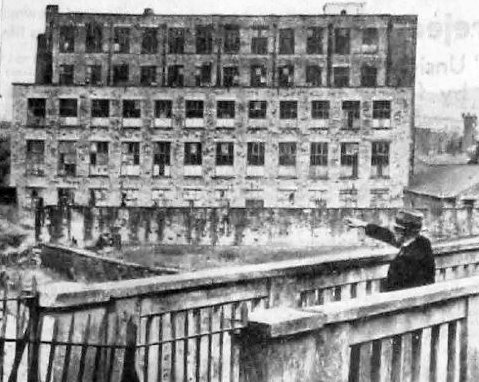
Alderman Sellers pointing to Shepley Mill from the George Street footbridge
Alderman Sellers pointing to Shepley Mill from the George Street footbridge.


The state of Shepley Mill (and the surrounding area) was one which continued to crop up. Alderman Richard Sellers suggested negotiating to convert the Shepley Mill premises into a bus station and public conveniences. He also suggested that by pulling three of the mill storeys down the stone could be used for house building on the site. An opinion piece was published in the “Watchman” column of the Glossop Chronicle on 29 September 1950:
What about Shepley Mill? Periodically, Shepley Mill comes up for discussion: nothing much ever comes of it: the mill continues to stand stark and derelict in the heart of the town, its "Sultan's turret caught in a noose of light." visible from all quarters. What's to be done with it? Alderman Sellers has been pressing the Town Council to acquire the building, demolish it to the height of two storeys, let off the two storeys as factories, or alternately use it as flats, and failing this, as a bus station. With the stone from the demolition, Alderman Sellers would build a hundred houses. It sounds an imaginative conception that smacks of such other ventures that took place after the first war. It is of course a pure speculation that like all speculations might either be very profitable or a heavy loss. The alternatives must be faced. The council, very wisely has decided not to turn down the proposal, but to engage an architect-surveyor to make a report on the suggestion and given an estimate of the cost of the proposed reconstruction. The report will take some time to get out, for architects are not nowadays running round looking for jobs: and it will be, as all architectural work is, expensive. That by the way. On the broader issue, there can be no doubt that if the council tackles this reconstruction problem alone, they will be extremely foolish. Shepley Mill is only a part of a much greater problem. The whole area from Wesley Chapel to Burgon's, and Market-street to the river which includes Chapel-street, Cross-street, George-street, the old Palace and Glove Factory needs planning as a whole. This is the only site left in the centre of the town upon which any public buildings could be placed, and quite apart form any local need for erecting public buildings, there will some day have to be erected by the County Council, a County College and-this area has the only possible site. It will have to be a clearance area.
The idea of adapting Shepley Mill as residential flats can be dismissed as impracticable. It doesn't need the employment of an architect to make that point clear. The dimensions of the building are such that the centre would have to be perpetually lighted by artificial means, and like the fats contemplated by Messrs. John Wood Bros. (Glossop) Ltd., they would have to be serviced and centrally heated. This latter is not in itself an objection unless the cost made the gross rents prohibitive, but the absence of natural lighting in the centre is a fatal objection. What will be the fate of this plan when it's been paid for? At the conclusion of the last war, in a burst of constructive zeal the council engaged Mr. John Beardshaw to plan the reconstruction of the Town Hall and ancillary buildings. A most intelligent plan was produced which provided for the retention of the present Assembly room, the construction of a dance hall much larger than the Victoria Hall, smaller lecture rooms, cloaks, lavatories. lounges, and the necessary bars. This is the second time within the last twenty-five years the Town Hall has been re-planned, the first being the design of Mr. Arnold Mitchell when our Borough Surveyor. The pigeon holes of the Surveyor's offices must be bursting with plans, and, one supposes that when the architect's fees have been paid, this one will go to keep company with its earlier brothers.


One of the problems which the Council faced was that the ownership of the mill was unclear. The Manchester Evening News of 12 May 1951 reported that Glossop Council was trying to trace the owners of Shepley Mill so that rate arrears could be claimed.

The council must have been successful because the dangerous state of the buildings arose again in 1953 and the Borough Surveyor was able to report to the Highways, Sewage, Buildings and Stores Committee on 9 June on the condition of the mill and that he had been in touch with the owners who were taking steps to shore the property up. This prompted a further opinion piece in the Glossop Chronicle:
The major question which confronts the local authority in this matter of tidying-up is what are they going to do about Shepley Mill? The matter has been discussed to the point of exhaustion without anybody having any clear conception as to who has the power to make an order, and when, if at all, such an order should be served. The public are entitled to an unequivocal statement from the authority as whether the building is really unsafe, for if so, the mere closure of the road to vehicular traffic is an inadequate precaution; the whole area should be evacuated.

The council then decided that legal proceedings be taken by the Town Clerk under Section 58 of the Public Health Act, 1936. In its issue of 17 July 1953, the Glossop Chronicle reported:
Glossop Magistrates, on Monday, made an order that Oldham Storage Co. Ltd., owners of Shepley Mill, should execute such work as may be necessary to obviate the dangerous condition of the mill within two months.
The magistrates said that they agreed that the mill was "an eyesore" and ordered that steps should be taken to improve the appearance of the building, particularly with regard to broken windows.
The application for an order to execute repairs at Shepley Mill or demolish the building on the ground that it was in a dangerous condition was made by the Town Clerk of Glossop
(Mr. Dolphin).
After hearing the evidence the three magistrates – with Mrs. W. H. Malloch presiding - paid a visit to the mill in the lunch adjournment of the court.
Mr. George Faulds, borough surveyors said that on May 25th he had inspected the tower at Shepley Mill and found it in a dangerous condition. On May 26th he rang the company in the morning and at noon the company rang him at his home and asked if he could arrange to close Chapel Street. This was done by 2 p.m. On the same day he had written to the company confirming the message about the mill's dangerous state. Mr. Faulds said that on June 3rd he again rang up to see what action the company was taking and on June 5th he was told that they had difficulty in obtaining a contractor and was asked if he could recommend anyone locally to do the work. He made a suggestion, contacted the firm, and asked if they would get in touch with the company and see what arrangements could be made. He had 'phoned the company on several occasions but the mill was in the same condition to-day.
Edward Charles Allan, deputy borough surveyor, said he inspected the tower from the inside on July 8th. The wartime occupants of the tower had placed glass indication plates on either side near the front wall so that the glass would crack if their was further movement. By each of these plates was a small board and the last date on which they
were visited was in September, 1944. In the case of all except the top storey the glass had cracked to an extent of not more than one eighth of an inch. Another plate had moved between half and three-quarters of an inch and Mr. Allan said that the main movement occurred between the ground and first floor level. The outer walls had moved outwards and the first floor walls had left the floor of the landing. "The tower is about seven storeys high and the weight is very considerable. If there is a weakness at the base it will be taking the whole weight of that tower," he added "In my opinion the tower is dangerous." He stated that additional vibration from traffic would tend to increase the danger and that during the past year there had been falls of stonework. By the side of Glossop Brook there was a wall which had fallen into the brook and caused a certain amount of obstruction to the brook course. In the event of flooding it would tend to increase the danger on the opposite bank. A further fall was likely as the stonework in the mill was "deteriorating rapidly" and had lost the key with the main brickwork.
Edward Hatton, managing director of the Oldham Storage Co., Ltd., owners of Shepley Mill, said he had dealt with more than 50 substantial buildings of this type in the last 20 years. He had formed the opinion that the movement, while serious. was "not imminently dangerous." He said that there had been difficulty in finding a contractor and then when they had got one he (Mr. Hatton) asked him for a report on the tower and proposals for dealing with it. He had not had these yet. "I am in absolute agreement with the requirement to do some repairs, but the urgency is not quite as great as would appear from the action of the local authority. These will be done. We are responsible people aware of our obligations and we shall attend to them."
The town clerk said that there had been plenty of time for the repairs to be done. The inhabitants of Chapel Street were being inconvenienced by the road being closed. He described the mill as "an eyesore" and asked for a further order because of its ruinous and dilapidated condition which was detrimental to the neighbourhood.
Mr. Hatton said he objected to that description of the mill. The extent to which it could be an eyesore was in the number of broken windows which they deplored as much as the local inhabitants but was there any point in putting in new windows until they had a use for the building?


At the council meeting on 29 July 1953, the Town Clerk reported that at the request of the Oldham Storage Co. Ltd., Chapel Street had been closed. The council instructed the Town Clerk to inform the company that the barriers were being removed and to point out that children were getting into Shepley Mill premises. They further authorised the Town Clerk be to engage Counsel for the hearing of the Appeal by the Oldham Storage Company at Quarter Sessions.
In the event the company did not act in a timely manner, it being 6 July 1954 before the Borough Surveyor could report to the Highways, Sewage, Buildings and Stores Committee that the Oldham Storage Company Ltd., had made arrangements to carry out the necessary demolition and re-building.
That turned out to be too little too late because, as the Manchester Evening News reported on 14 August:
Part of Chapel-street, Glossop, was closed to traffic today because Shepley Mill, an unused three-storey building, which stands just off the street, was said to be dangerous. There was no fall of stone or brick, but the road was closed as a precaution.
And a week later:
Five families, including eight children, evacuated cottages in Chapel-street, Glossop, following the collapse in the storm of Shepley Mill, a four-storey unused building, waited anxiously to-day to learn when they could return. All stayed the night with relatives and friends. Police were on guard and 30 yards of the street were cordoned off.

Shepley Mill following the collapse
Shepley Mill following the collapse.


The Glossop Chronicle of 27 August published a fuller report:
Five families, including eight children, were evacuated on Friday night from cottages in Chapel Street following the collapse of part of Shepley Mill, an 80-year-old, five-storey unused building. They were allowed to return when the premises were rendered safe. The town was shaken by a terrific noise as part of the 100 ft. mill collapsed shortly after four o'clock. About 300 tons of stone and debris hurtled into the mill yard and over the wall into Chapel Street.
What nearby residents had feared would happen for many months became a near-tragedy
as children dashed for safety and women screamed. This week townsfolk have asked: Why was the mill allowed to get into such a state? It is understood that the top storeys of the mill will be demolished.
Glossop Town Council have received many complaints about the old mill and they made many requests to the owners. Early last week workmen were there making it safer.
Townsfolk, and people who visited the town with the apparent object of just seeing the shell of the mill after hearing of its collapse, looked at the stonework and girders hanging ominously above Chapel Street.
There was another slight fall of masonry in the early hours of Saturday morning.
The families were evacuated within a few hours of the collapse of the mill which stands only 20 yards from some of the cottages.
As soon as he heard of the collapse the Mayor of Glossop, Councillor H. Turner, went to the spot with other corporation officials. The borough surveyor, Mr. Allen was on holiday.
Immediately the Mayor told the families: “If necessary we shall take care of all the families affected till the mill is made safe.” He held a hurried meeting with members of the corporation and the owners of the mill - Oldham Storage Co. - were contacted. Discussion went on for a long time on Friday evening and again on Saturday morning at a meeting on the site.
Beryl Clinton (11) ran screaming to safety when she heard the first rumbles of the collapse. She had been playing in the shadow of the wall surrounding the mill and narrowly missed being hit by falling debris. She was so frightened she was unable to eat her tea.
A 77-year-old pensioner, Mrs. C. A. Harrison, who lives alone near the mill, was reading when she heard the walls collapse. “It was a terrible noise,” she said. “My heart went in my mouth I was frightened to death.” She left her home and belongings to stay with relatives in the town.
Fifty-seven-years old Mrs. Nellie Aldous, whose home faces the collapsed part of the mill, told a reporter: "I had just been to the front door and heard a terrific crash which sounded like thunder. "I looked out and saw part of the mill tower hurtling down. I shouted, “My God, the mill is falling, and we all rushed out into the street.” Mrs. Aldous, whose husband is in hospital added: “Children in the street have played in the shadow of Shepley Mill for months. It has always looked dangerous and there are a lot of children in the neighbourhood. I have been frightened to go to bed at nights and have been nervous at the slightest sound because I always thought something like this would happen. It has been a strain trying to keep the children away from the mill.”
Five children lived at her cottage. They are aged between 10 months and 12 years.
Bed and belongings were taken by the families to the homes of relatives and friends, although the corporation had offered an empty council house if they did not find accommodation.
In the same cottage as Mrs. Aldous were Mrs. Burwood and her two children, Mrs. Winnie Aldous and her three children, and Mr. Norman Garlick, their nephew. Next door lived Mr. and Mrs. T. Pickup and their four-year-old son. Another of the families in the cottages in the danger area were Mr. and Mrs. Gibson and their 14-months-old son. Mrs. Aldous has lived in the cottage 15 years. She was born only just round the corner in George Street. The strain of keeping five children away from Shepley Mill has been added to the worry of her husband's illness. He has been away for treatment for a month.
Standing with her at the door of her home were Geoffrey Aldous (12), Diane Burwood (10). Roger Aldous (8), Peter Aldous (3) and ten-months-old Nicholas. “In one way I'm glad this has happened as perhaps they will pull all the mill down now, and reduce the danger. It's been getting on our nerves,” said Mrs. Aldous, and she was expressing the views of many of her neighbours.
Mr. Alf Oldham, licensee of the Rose and Crown, High Street West, said: “I was in the yard with my wife. There was a terrific noise and I could hardly see anything but dust.”
“Alderman Richard Sellers said: "I had been having a look at the mill only about 15 minutes before it collapsed. I know it has looked dangerous for a long time and have urged the council to do something. It is a miracle no-one was seriously hurt.”
At the last meeting of Glossop Town Council Alderman Sellers had grimly asked: “Are we going to wait until somebody is killed before we take action over Shepley Mill?”
Police patrols have guarded the remains of the mill all week and part of Chapel Street has been closed. Rope barriers were put up.
All week a special watch has been kept to see that children do not venture near the site.
The firm say that the demolition work has been done as quickly as possible.
So five houses in Chapel Street remain unoccupied.
Townsfolk have called it Glossop's “terror street” in recent weeks. As children played in the gaunt shadow of this old cotton mill (disused and nothing better than an eyesore for years) older people have stood aghast as the mill's condition became more dangerous.
It has been a street of tension. Uneasiness has brooded over the people even in daylight.
A member of Glossop Town Council said this week: “We did all we could to get improvements to the mill carried out before
”.

The collapse did finally result in action being taken, though that was not without mishap and a member of the demolition team was fortunate not to be killed. The Glossop Chronicle of 12 November 1954 reported the accident:
A 20-year-old father of two plunged nearly 30 feet amid a pile of dust and debris when part of Shepley Mill on which he was working collapsed beneath his feet on Tuesday afternoon. The man, Jack Wild of Platt Street, Padfield, was badly injured about the head and received injuries to his stomach and back.
He was taken by Glossop ambulance to Ashton General Hospital, and after treatment in the casualty ward was detained. Yesterday (Wednesday) he was "a little better."
Wild, on the day the accident happened, was working on the southern end of the mill with Alec Foy (26) of Post Street, Padfield. They were knocking a portion of brickwork into the yard below. Suddenly, the floor on which the two were standing gave way and Foy was left standing on the brink of a gaping hole his colleague below half-buried in the broken bricks and masonry. The two remaining members of the team, Joe Parker, of Hadfield Square, Glossop, and Jim Lynn, Worthington Street, Stalybridge, were working on another section of the 80-year-old mill. One rushed for the ambulance, the other helped Foy to extricate Wild. Mr Foy accompanied the injured man to hospital.
Later the contractor Mr. Frank Walker, after viewing the scene of the mishap, ordered work to be resumed. “It was just one of the hazards of the job” he commented
Mr Walker has been engaged by the owner of Shepley Mill to make the structure safe, since the collapse of the main walls in August. He estimates that the work will finish in about a month.


The mill was still only party demolished as the Highways, Sewage, Buildings and Stores Committee on 8 March 1955 received a report from the Deputy Borough Surveyor on the condition of the mill chimney and on complaints that had been received. The council agreed to request Mr. Hatton to arrange for its demolition by the next meeting of the committee and for legal proceedings to be taken should he fail to do so. Mr Hatton took no action so the legal proceedings were set in motion and, at the committee meeting on 6 September, the Borough Surveyor reported that he had made arrangements for the inspection of the chimney by a firm of steeplejacks.

It was still over a year before anything happened. On 5 June 1956 the Highways, Sewage and Buildings Committee authorised the Town Clerk to take proceedings under Section 58 of the Public Health Act, 1936, in respect of the Mill and chimney. Those proceedings were started but then adjourned as a result of an undertaking given by the Oldham Storage Company to carry out work to the structures.

It was not until October that the chimney finally came down, and even then not without incident. The Manchester Evening News of 10 October 1956 reported:
Twelve sticks of gelignite weighing 1½ lb., to-day failed to fell a 120ft. chimney at Shepley Mill, Glossop. The chimney toppled at the second blast, however. Glossop Corporation recently took the owner of the chimney to court, saying it was unsafe and liable to fall at any time. To-day, hundreds of people thronged the streets, police stopped traffic, and children were brought out of nearby St. Mary's Catholic School. More than 100 workers at Flexy Brushes, Ltd., about 50 yards from the chimney, moved out.
Then the crowd waited tensely for the big bang. But the first charge, which blew a big hole in one corner of the chimney base, did not even sway the stack. Four workmen then hacked at the stone with crowbars in an effort to get the chimney down but their efforts were unsuccessful. The contractor in charge, Mr. Albert Pennington of Ripponden Road, Oldham, said: “I have never known this happen before. It is simply incredible.
”.

Proceedings were then adjourned again to allow the company to deal with the problems properly but the company still did not do so. A report in the Glossop Chronicle of 8 March 1958 stated:
Glossop magistrates on Wednesday made an order instructing the Oldham Storage Co. Ltd. to effect certain repairs at their derelict Shepley Mill, Glossop. The order stipulates that the repairs must be done within three months but on the application of Mr Colin Campbell, Glossop's town clerk, the order will be suspended for three months to give the company chance to do the work without the order being put into effect.
Mr Campbell told the magistrates that the corporation had laid a complaint against the company in July last year. Since then a dangerous mill chimney at the site had been felled and certain demolition and repair had been done after the company had given an undertaking in court. Since October last year there had been no further work at the site except a certain amount which had been done on the day prior to the court hearing.
Mr Campbell spoke of the work which had been done to make the mill safer and Mr E. C. Allen, the borough surveyor, said he had inspected the site on February 26th and the two main danger points were still those adjacent to Chapel Street and the south corner overlooking Glossop Brook. He described some moving cracks in the masonry and thought there was a danger of masonry falling into Chapel Street. The safest way to deal with the situation was to throw a protective cover over the building when It had been reduced to two-storey level.
For the company Miss J. Littlewood said there was no objection to an order being made so long as it embodied certain specific conditions and the order was as follows:
The old engine house to be demolished down to bottom window sill level; the new engine house to be demolished; the whole of the third floor to be demolished so that the roof level will be the same as the smaller new building on the site; quotations to be obtained by the company for roofing the floor of the third floor; the gap left by the old tower to be replaced by a stairway or other means to render the north-west wall safe.
Miss Littlewood said the company would not object to such an order and she pointed out that the withdrawal of the workmen In October has not been done frivolously. They had been moved to a more urgent job at a mill where machinery was being installed.
The order would, in effect, she said, give the company six months to do the necessary work but Mr Campbell pointed out that the corporation would prefer the work to be done in the three months “grace
”.

Even so, the company failed to act and on the 6 March 1957, the Magistrates' Court ordered the Oldham Storage Company, Limited, to carry out the work within a period of six months and to pay part of the Corporation's costs and their court fees.

Despite the court order, it was not until its issue of 13 December 1957 that the Glossop Chronicle could report:
People who live in the vicinity of Shepley Mill in constant fear that the ruins might come tumbling down on their cottage homes at any time will be relieved to know that Glossop Council is taking further steps to make the building safe.
At a recent court hearing the owners of the mill, Oldham Storage Co., were ordered to make the old mill safe, but the town clerk, Mr Colin Campbell, has had to report to the council that the court order has not yet been complied with.
Now the council has instructed Mr Campbell to take the necessary steps to recover all the outstanding costs which were awarded against the company by the court and the borough surveyor, Mr E. C. Allen, has been asked to submit to the Buildings Committee an estimate of the cost of carrying out the work under the Public Health Act.

Under this Act local authorities have powers to carry out demolition work within the limitations imposed by the court order to the owners and to recover the cost of the work from the owners.
At last week's meeting of the council, Councillor Gordon Hurst said “We are at last seeing the disintegration of the mill. It is being destroyed in a legal and proper manner and ultimately we shall have the removal of this eyesore
”.
and, on 14 February 1958:
Shepley Mill, that dangerous, derelict shell in the heart of Glossop, is coming down – completely except for the newer, smaller extension which is in quite good condition, and that will be made safe.
Workmen have been given instructions to raze the building to ground level, and it is expected that the site will be cleared within about four months.
Councillor H. Turner was rightly concerned at the last meeting of Glossop Town Council that the public of Glossop should know the fate of the mill, but he was advised not to press the point because as the Mayor, Councillor C. Woolley, pointed out, the council was not in full possession of all the relevant information.
This week a Chronicle reporter visited the site, talked with the workmen, and discovered the news which should put a lot of householders near the mill at ease for the first time in many months. They have lived in fear of the building crashing down on their homes or on children at play.
The mill has been the centre of a controversy which has involved action inside both the council chamber and the magistrates' court. At one time it was thought that only certain parts of the mill would be removed and an order by the court restricted the demolition work. Now, it is understood, the mill has been sold and the site will be cleared with the exception of the smaller extension.


All in all, Shepley Mill had what the Chronicle called, after the 1954 collapse, “a varied career; a century of struggle with adversity” and went on to say “It is not one of the old established mills that simply collapsed as a result of the recapitalisation boom of the 1920's; it seems to have suffered periods when it had a desperate struggle to survive.”
Former workers at the mill spoke well of the days when they worked at Shepley Mill as spinners. When in full work, they said, “good money was earned”. Overall, though, plenty of good money was lost at Shepley Mill.


Return to GJH.me Home Page, Return to Glossop Area Local Histories index.


Last updated: 19 August 2025